Schedule delay & planning analysis.
Construction schedule delays are rarely simple. Most delay disputes involve multiple overlapping causes, inadequate documentation, and significant financial consequences that extend well beyond the cost of the delay itself. Understanding the contributing causes of a delay and what it actually cost requires both construction expertise and careful analysis of the project record.
Overview
Florida Construction Schedule Delay Analysis and Expert Witness Services
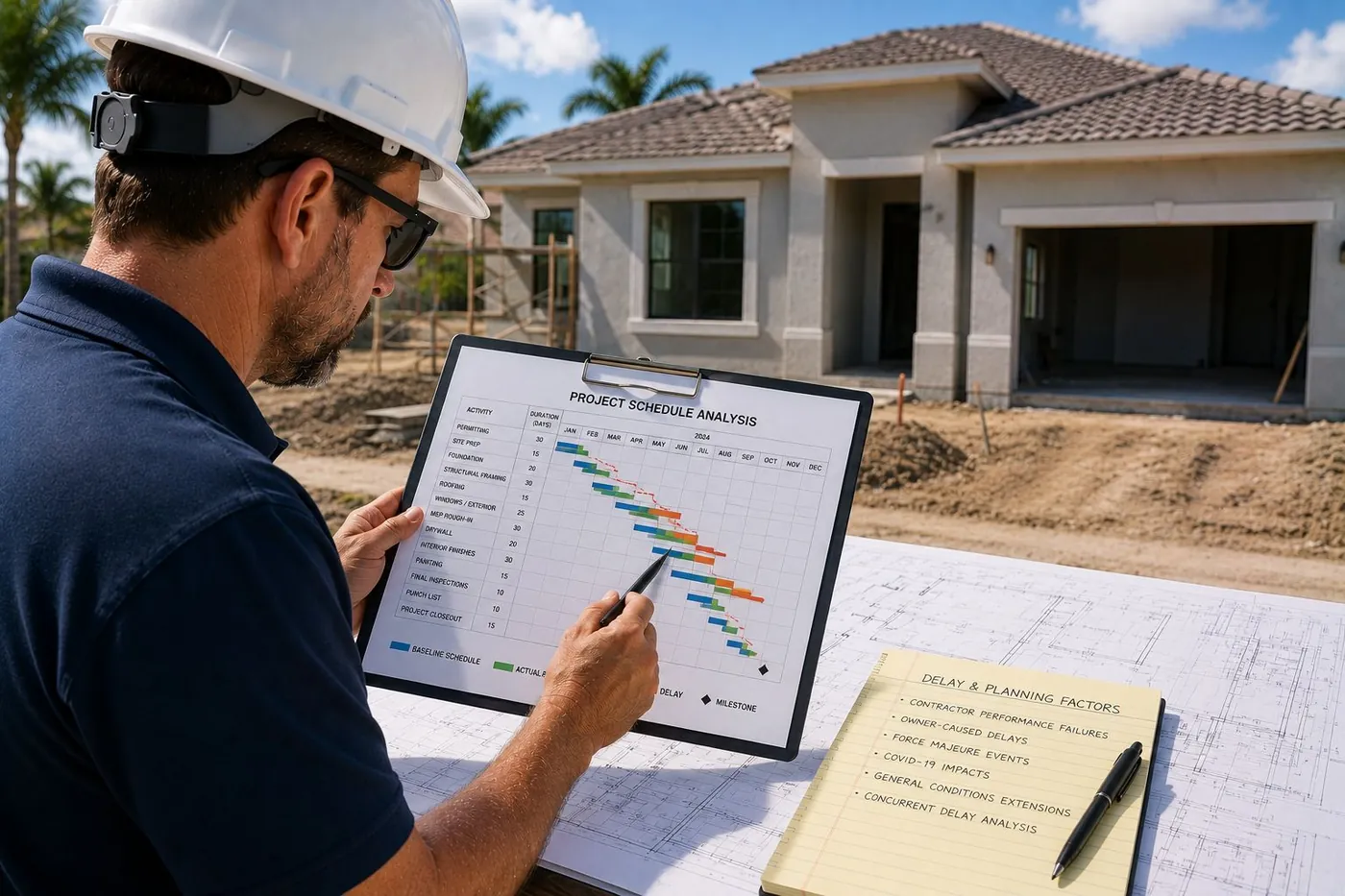
Construction schedule delays are among the most contested and financially significant issues in Florida construction disputes. A delay that pushes a project completion date back by weeks or months does not just affect the calendar - it generates ongoing costs for every party involved and can trigger claims and counterclaims that can be substantial. Whether the delay was caused by contractor performance failures, design changes, owner-caused disruptions, material shortages, weather events, or force majeure conditions, understanding what happened requires careful evaluation of the project record and a working knowledge of how construction projects are actually planned, sequenced, and executed.
Cloud Design Build provides construction schedule delay analysis and expert witness services throughout Florida, assisting property owners, developers, contractors, attorneys, and insurers in evaluating the contributing causes and costs of construction delays. These services are part of Cloud Design Build's broader Construction Claims Consulting practice and may include schedule review, project documentation analysis, delay cause evaluation, cost impact analysis, and litigation support. For complex critical path method (CPM) schedule analysis, Cloud Design Build works in conjunction with qualified scheduling consultants to provide comprehensive delay analysis support.
Definition
What is a Construction Delay Claim?
A construction delay claim arises when one party to a construction contract asserts that the project was delayed beyond its contractual completion date and that the other party bears responsibility for that delay and its associated costs. Delay claims may be brought by contractors against owners for owner-caused delays, design changes, or failure to provide timely information and decisions. They may also be brought by owners against contractors for failure to maintain schedule, poor performance, or inadequate project management.
Delay claims are among the most complex and document-intensive disputes in construction litigation. They require a systematic review of the project schedule, daily reports, meeting minutes, correspondence, change orders, submittals, and weather records to reconstruct the actual sequence of events on the project and identify the causes and timing of delays.
Excusable vs Compensable Delays
Delay claims are typically categorized as follows. Entitlement depends on the contract and applicable law.
- Excusable delays: Delays caused by events beyond the contractor's control - weather events, force majeure conditions, or acts of God - for which the contractor is entitled to a time extension but not necessarily additional compensation.
- Compensable delays: Delays caused by the owner or owner's agents - design changes, late approvals, differing site conditions, or owner-furnished materials that are not delivered on time - for which the contractor may be entitled to both a time extension and additional compensation for the costs incurred during the delay period.
- Non-excusable delays: Delays caused by the contractor's own performance failures - poor planning, inadequate staffing, subcontractor management failures, or failure to maintain schedule - for which the contractor is generally not entitled to either a time extension or additional compensation.
Causes
Common Causes of Construction Delays in Florida
Construction delays in Florida arise from a wide range of causes, and most significant delay disputes involve multiple contributing factors that overlap and interact. Common delay causes that Cloud Design Build evaluates include:
Contractor Performance Issues
Contractor performance failures are among the most common causes of construction delays. These may involve inadequate staffing, poor subcontractor management, failure to maintain schedule, improper sequencing of work, or failure to identify and address problems before they affect the critical path. Evaluating whether a contractor's performance fell below the standard of care expected for the project is frequently central to a delay claim analysis. See also: Construction Standard of Care.
Design Changes
Design changes, incomplete drawings, and conflicts between project documents are a significant source of construction delays. When the design is not complete or coordinated at the time construction begins, contractors encounter conditions in the field that require clarification, redesign, or change orders that disrupt the planned construction sequence. The timing and scope of design changes relative to the affected work is an important part of any delay analysis.
Owner-Caused Delays
Owners can cause or contribute to construction delays in a variety of ways, including failure to provide timely decisions on submittals and RFIs, slow change order processing, delayed delivery of owner-furnished materials or equipment, failure to obtain required permits or approvals, and interference with the contractor's work. When owner actions or inactions affect the contractor's ability to maintain schedule, the owner may bear responsibility for the resulting delay and its costs.
Material and Supply Chain Delays
Material availability and supply chain disruptions are a recurring source of construction delays in Florida, particularly for long-lead items such as structural steel, mechanical equipment, windows, doors, and specialty materials. Whether a material delay was foreseeable and should have been accounted for in the project schedule, or whether it constitutes an excusable delay beyond the contractor's control, depends on the specific circumstances and the contractual provisions governing force majeure and delay excuses.
Weather and Force Majeure
Florida's weather creates specific delay risks that must be evaluated in the context of the project location, time of year, and the nature of the work being performed. Hurricane events, tropical storms, and periods of sustained rainfall can affect construction schedules significantly, particularly for work that cannot be performed in wet conditions or that requires dry weather for materials installation. Evaluating whether a weather-related delay was truly beyond the contractor's control, or whether adequate contingency was built into the schedule, is an important part of force majeure delay analysis.
COVID-19
The COVID-19 pandemic created unprecedented delay and disruption across Florida construction projects, affecting labor availability, material supply chains, permitting processes, and project financing. Projects that were mid-construction during 2020 through 2022 frequently experienced significant schedule disruptions and cost escalation that generated claims and disputes between contractors and owners. Evaluating the specific impacts of pandemic-related conditions on a particular project requires careful analysis of the project record in the context of the general conditions that existed at the relevant time.
Permitting and Regulatory Delays
Permitting delays from local building departments are a common source of construction disruption in Florida, particularly in high-volume construction markets where building department review times can be significant. Evaluating whether permitting delays were attributable to the contractor's failure to properly prepare and submit permit applications, to the owner's failure to provide required information, or to regulatory processing times beyond either party's control is an important part of delay cause analysis.
Coordination Failures
Coordination failures between trades - where one subcontractor's work affects another's ability to proceed - are a frequent source of schedule disruptions that may be difficult to attribute to a single responsible party. Evaluating coordination failures requires an understanding of how construction work is sequenced, what coordination obligations each party had under the contract, and whether adequate project management was in place to identify and resolve coordination issues before they affected the critical path.
Documentation
The Documentation Problem in Delay Claims
Schedule delay disputes are fundamentally documentation disputes. The party with the better project records often has the stronger position. Yet inadequate documentation is one of the most consistent problems encountered in construction delay evaluations - and it affects both contractors and owners.
Failure to Issue Timely Delay Notices
Construction contracts commonly require written notice of a delay within a set time after the event. Whether late or missing notice affects a party's rights depends on the contract and applicable law. Reviewing whether notices were given, when, and what they said is part of a delay evaluation.
Concurrent Delays
Concurrent delays - where delays from multiple causes overlap in time - are among the most complex and frequently disputed issues in delay claims. When the project record shows delays from both contractor performance failures and owner-caused events occurring simultaneously, identifying the contributing causes of the resulting schedule impact requires careful analysis of which events affected the critical path and when. A common pattern in delay disputes involves situations where concurrent delays were not documented properly, or were not documented in a way that obscures the concurrent nature of the delay. Evaluating the project record to identify concurrent delay conditions and assess their contributing causes is a significant part of complex delay claim analysis.
Incomplete or Absent Baseline Schedules
A baseline schedule - an approved project schedule established at the outset of the project against which actual progress is measured - is the foundation of any delay analysis. Without a credible baseline schedule, it is difficult to demonstrate what the planned sequence of work was, when work was supposed to be completed, and how actual events deviated from the plan. Many construction disputes are complicated by the absence of a formal baseline schedule, schedules that were never updated to reflect actual conditions, or schedules that were not maintained or updated.
Delay costs
What Property Owners and Developers Need to Know About Delay Costs
One of the most important and least understood aspects of construction delay claims is that the cost of a delay is not limited to the value of the work that was not performed. Every day a construction project is delayed generates ongoing costs - for the contractor, for the owner, and for any financing that is in place. Understanding these costs is essential for property owners and developers who may be involved in a delay dispute.
General Conditions Extensions
General conditions, such as supervision, temporary facilities, equipment, and overhead, continue to accrue while a project is open. Whether and how those costs are recoverable depends on the contract and the facts of the dispute.
Termination Risk
Terminating a contractor can have significant legal and financial consequences that depend on the contract and the facts. Owners should consult a Florida construction attorney before taking that step.
Developer and Investor Exposure
Developers and investors may not always be aware of the delay costs that are accumulating on a troubled project until a formal claim is made. Contractors who fail to submit timely delay notices or change order requests may be building up a significant claim while the project continues - and the owner receives the formal demand only when the contractor stops work or the project reaches completion. Understanding the delay and cost escalation exposure on an active project, and taking steps to document and manage that exposure before it becomes a formal claim, is an important part of construction project oversight.
Evaluation
How Cloud Design Build Evaluates Construction Schedule Delays
Construction schedule delay evaluation requires a systematic review of the project record combined with a practical understanding of how construction projects are planned and executed. Cloud Design Build's delay evaluations focus on developing a clear, defensible understanding of what caused the delay, when it occurred, and what its cost impacts were.
Depending on the scope of the engagement, a schedule delay evaluation may include:
- Review of contract documents including schedule requirements, notice provisions, and force majeure clauses
- Review of the baseline project schedule and any schedule updates or revisions
- Evaluation of daily reports, meeting minutes, correspondence, and project documentation for delay evidence
- Assessment of delay notice compliance and the adequacy of delay documentation
- Identification of concurrent delay conditions and their contributing causes
- Evaluation of general conditions and general requirements extension costs
- Review of change orders and their schedule and cost impacts
- Assessment of pandemics, epidemics, weather, and force majeure delay conditions as applicable
- Coordination with qualified scheduling consultants, who perform formal schedule analysis such as CPM and time impact analysis
- Preparation of written reports and expert opinions
- Litigation support including deposition preparation and trial testimony
Credentials
Why Cloud Design Build
Effective schedule delay analysis requires more than reading a project schedule. It requires understanding how construction projects are actually planned, sequenced, and managed in the field - and where the gap between planned and actual performance typically originates.
Cloud Design Build is led by James J. Cloud, a Florida Certified General Contractor and builder with experience managing construction schedules, subcontractor coordination, and project documentation across residential, luxury, and commercial construction throughout Florida. That active construction management experience provides practical insight into how delays develop, how they are documented, and where the documentation failures that complicate delay disputes most frequently occur.
For complex matters requiring formal CPM schedule analysis, Cloud Design Build works in conjunction with qualified scheduling consultants to provide comprehensive delay analysis support. This collaborative approach supports bringing both the construction expertise and the scheduling methodology required for rigorous delay analysis to the engagement.
Cloud Design Build evaluates delay claims on behalf of property owners, contractors, developers, and insurers on both sides of construction disputes.
Cloud Design Build's consulting and expert witness services are listed with the SEAK Expert Witness Directory, JurisPro Expert Witness Directory, and Expert Pages.
Questions
Schedule delay analysis, answered.
Schedule a consultation
Discuss your matter with James directly.
Cloud Design Build accepts construction schedule delay analysis and expert witness engagements throughout Florida, including South Florida, Southwest Florida, Miami, Fort Lauderdale, Naples, Punta Gorda, and surrounding markets. To discuss a matter, contact us to schedule a consultation.