Construction fraud & misrepresentation.
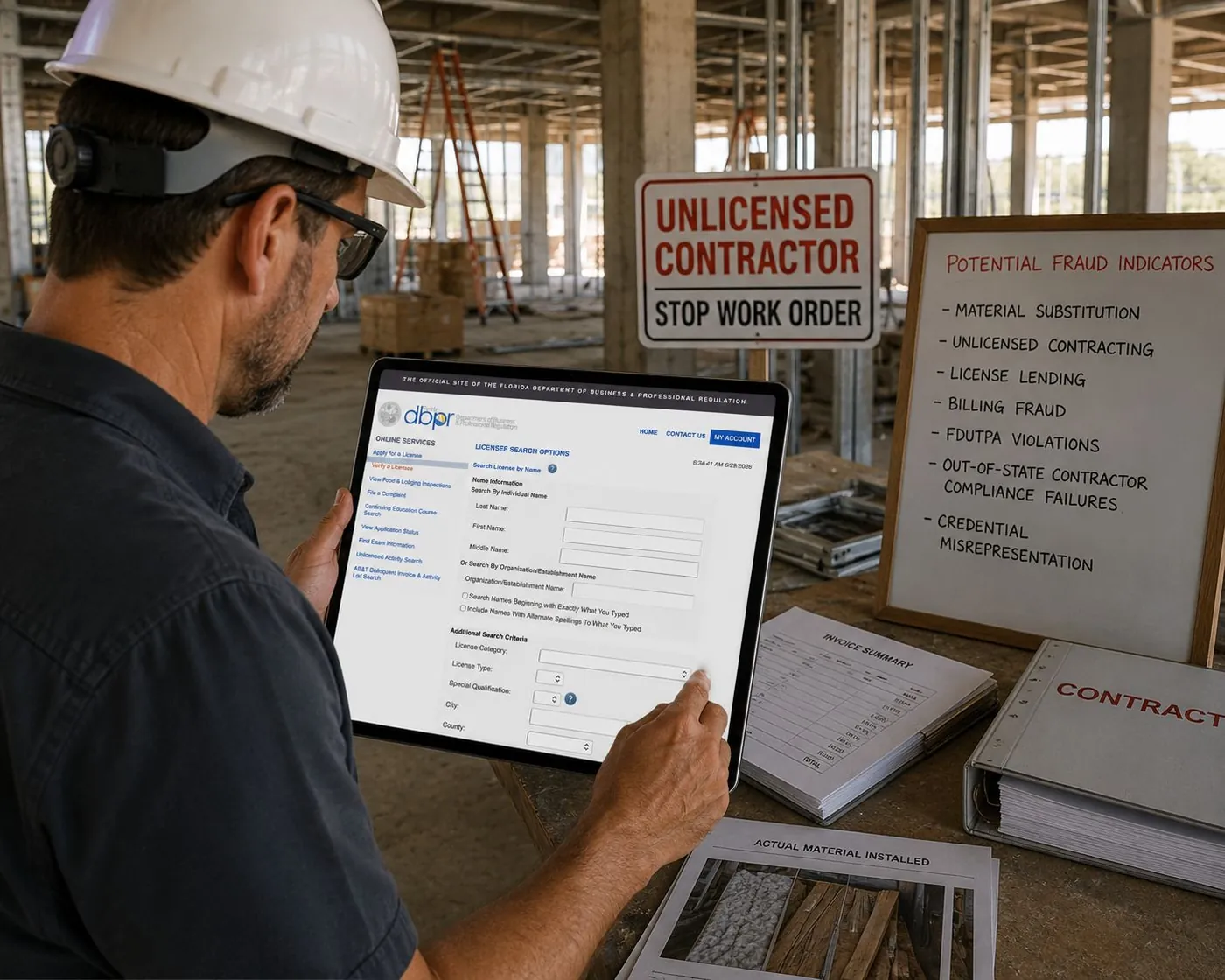
Construction fraud in Florida takes many forms - from material substitution and billing for work not performed, to unlicensed contractors misrepresenting their credentials, to out-of-state operators unaware of or deliberately ignoring Florida's licensing, permitting, and product approval requirements. Identifying what actually happened requires someone who knows construction from the inside.
Overview
Florida Construction Fraud Expert Witness and Consulting Services
Construction fraud and misrepresentation are more common in Florida's construction market than most property owners and even many attorneys realize. The same conditions that make Florida one of the most active construction markets in the country - high volume, rapid growth, significant property values, and a complex regulatory environment - also create conditions where fraud thrives. Unlicensed operators, material substitutions, billing for work not performed, and contractors who misrepresent their qualifications, credentials, or compliance with Florida's specific requirements all generate disputes that require a construction expert who can evaluate what was actually done - and what was not.
Cloud Design Build provides construction fraud and misrepresentation consulting and expert witness services throughout Florida, assisting property owners, attorneys, developers, and insurers in evaluating construction fraud conditions and supporting dispute resolution. These services are part of Cloud Design Build's broader Construction Claims Consulting practice and may include site inspection, document review, licensing analysis, material and workmanship evaluation, and litigation support.
The statute
FDUTPA - Florida Deceptive and Unfair Trade Practices Act
The Florida Deceptive and Unfair Trade Practices Act, commonly referred to as FDUTPA, is one of the legal frameworks under which construction fraud and misrepresentation claims may be pursued in Florida. FDUTPA prohibits unfair methods of competition and unfair or deceptive acts or practices in the conduct of trade or commerce.
In construction disputes, Florida's consumer protection laws may apply in situations where a contractor or supplier misrepresented the nature, quality, or compliance of their work or materials, where a contractor falsely represented their licensing or qualifications, or where a contractor engaged in deceptive billing practices.
Cloud Design Build has been retained in matters where attorneys have asserted FDUTPA claims in connection with construction disputes. Cloud Design Build's role in these matters is to evaluate the construction conditions at issue: what work was performed, what was specified or represented, what exists in the field, and how those compare. We document those findings and the basis for them. Whether a difference reflects intent or amounts to fraud is a legal determination for the court or fact-finder.
Fraud patterns
Common Forms of Construction Fraud in Florida
Material Substitution Without Disclosure
Material substitution is one of the most frequently encountered forms of construction fraud in Florida. It occurs when a contractor installs materials or products that differ from what was specified in the contract documents or represented to the owner - without the owner's knowledge or consent. Material substitutions may involve lower-grade products, products not approved for the intended application, or materials that do not meet the performance requirements of the project specifications.
Material substitution fraud is particularly significant in Florida because of the state's specific product approval requirements. In High Velocity Hurricane Zone (HVHZ) jurisdictions covering Miami-Dade and Broward Counties, products must carry valid Notices of Acceptance (NOAs) and be installed per approved methods. Installing non-approved products, or approved products installed outside their approval conditions, while representing compliance with these requirements is a form of material misrepresentation with direct safety and code compliance implications.
Evaluating material substitution fraud requires a construction expert who can identify what was actually installed, compare it to what was specified and approved, and document differences between what was specified, represented, billed, and built. As an active licensed contractor who reads and builds from construction documents daily, James J. Cloud brings direct, current expertise to these evaluations.
Billing for Work Not Performed or Not Completed
Billing fraud occurs when a contractor invoices for work that was not performed, materials that were not installed, quantities that were not delivered, or a percentage of completion that does not reflect actual progress. This form of fraud may involve inflated pay applications, change orders for work that was not authorized or not performed, or invoices for materials that were billed but never delivered to the project.
Identifying billing fraud requires careful comparison of what was invoiced against what was actually constructed in the field. A construction expert with active building experience can evaluate the as-built conditions against the billing records and document differences between what was specified, represented, billed, and built.
Contractor Credential and License Misrepresentation
Contractor credential misrepresentation occurs when a contractor represents that they hold a license, certification, or qualification that they do not actually possess. In Florida's regulated construction environment, this may involve a contractor falsely representing that they hold a state-certified general contractor license, a specialty trade license, or a local certificate of competency required for work in a specific jurisdiction.
While outright license fabrication is less common than other forms of construction fraud, it does occur. More commonly, credential misrepresentation takes subtler forms: representing that a license covers work outside its authorized scope, failing to disclose that a license is suspended or has open complaints, or presenting a qualifying agent's credentials as personal qualifications when the individual has no meaningful relationship with that license.
Unlicensed Contractors and Handymen Performing Licensed Work
One of the most common and consequential forms of construction fraud in Florida involves unlicensed individuals or businesses performing work that requires a licensed contractor. Florida law provides a limited exemption from contractor licensing for certain minor work. The exemption carries several conditions beyond the contract price, and it does not apply when the work is part of a larger project. Licensing and permitting are separate questions: permits are governed by the Florida Building Code and local ordinances based on the type and scope of work, so work that falls under the exemption may still require a permit.
In practice, unlicensed operators frequently blur the line between handyman services and licensed contracting by breaking larger projects into smaller invoices, misrepresenting the scope of work, or simply performing licensed work without disclosure of their unlicensed status. When property owners hire someone they believe is performing handyman services and that person performs work that requires a license - electrical, plumbing, structural, roofing, or other regulated trades - the resulting work may be unpermitted, non-compliant, and potentially dangerous, with the property owner bearing the consequences.
Material Suppliers and Non-Contractor Installers
A specific and increasingly common form of construction fraud involves material suppliers who sell and install products - acting in the capacity of a contractor - without holding the required contractor's license. A supplier who delivers and installs roofing materials, windows, doors, flooring, or other building products may be performing contracting work under Florida law. When those installations require permits, must comply with product approval requirements, or must meet Florida Building Code standards, an unlicensed supplier-installer creates the same compliance exposure as any other unlicensed contractor.
Cloud Design Build documents what was installed and by whom, and whether the resulting work met applicable code and quality standards.
Out-of-State Contractors in Florida
Florida's construction market regularly attracts out-of-state contractors, particularly following hurricane events and during periods of high construction volume. Out-of-state contractors unfamiliar with Florida's specific requirements - or deliberately operating outside those requirements - are a significant source of construction fraud and misrepresentation claims in the state.
Florida-specific requirements that out-of-state contractors frequently fail to comply with include:
- State contractor licensing under Chapter 489, Florida Statutes - a license valid in another state does not authorize construction work in Florida
- Local registration requirements in jurisdictions where the contractor intends to work
- Florida Building Code requirements that differ from other states' codes
- HVHZ product approval requirements in Miami-Dade and Broward Counties - NOAs and Florida Product Approvals that may be unknown to out-of-state contractors accustomed to different regional standards
- Florida permitting requirements and the obligation to pull permits before commencing regulated work
- Hurricane season construction standards and wind resistance requirements that are specific to Florida's geographic exposure
When an out-of-state contractor performs work in Florida without proper licensing, without required permits, or without compliance with Florida-specific product and installation standards, and represents their work as code-compliant and properly licensed, those misrepresentations may give rise to claims that an attorney can evaluate.
Post-Hurricane and Disaster-Related Fraud
Following major hurricane events in Florida, the construction market is flooded with out-of-state contractors, unlicensed operators, and fraudulent actors who take advantage of property owners desperate for repairs. Common post-hurricane fraud patterns include contractors who collect deposits and perform little or no work, contractors who perform work without permits using non-approved materials, and contractors who misrepresent their licensing and insurance status to secure contracts from storm-affected property owners. Documenting discrepancies in these situations requires a construction expert who knows what compliant work looks like and can clearly articulate what was misrepresented and what was not done.
Our method
How Cloud Design Build Evaluates Construction Fraud Claims
Cloud Design Build's role in these matters is to evaluate the construction conditions at issue: what work was performed, what was specified or represented, what exists in the field, and how those compare. We document those findings and the basis for them. Whether a difference reflects intent or amounts to fraud is a legal determination for the court or fact-finder.
Depending on the scope of the engagement, a construction fraud evaluation may include:
- Site inspection and documentation of as-built conditions
- Comparison of installed work against contract documents, specifications, and represented scope
- Material identification and evaluation against specified and approved products
- Review of billing records, pay applications, and change orders against actual construction progress
- Contractor and subcontractor licensing verification through DBPR and local licensing records
- Review of licensing records and documentation relevant to alleged unlicensed activity
- Florida Building Code and NOA compliance evaluation for installed products and systems
- Assessment of out-of-state contractor Florida compliance including licensing, permitting, and product approvals
- Review of project documentation including contracts, invoices, correspondence, and permit records
- Preparation of written reports and expert opinions
- Litigation support including deposition preparation and trial testimony
Credentials
Why Cloud Design Build
Evaluating construction fraud effectively requires an expert who knows what legitimate construction looks like - because documenting discrepancies means being able to articulate clearly what was represented, what was built, and why the difference matters.
Cloud Design Build is led by James J. Cloud, a Florida Certified General Contractor, Licensed Roofing Contractor, Licensed Mechanical Contractor, Licensed Pool/Spa Contractor, Licensed Plumbing Contractor, and Licensed Real Estate Broker, with ICC building inspector certifications across residential and commercial construction. As an active licensed contractor building projects in Florida, James reads construction documents, pulls permits, coordinates inspections, and manages subcontractors on current projects. That active construction experience provides direct, current knowledge of what compliant work looks like - and what departures from that standard represent.
Cloud Design Build accepts construction fraud and misrepresentation consulting and expert witness engagements on behalf of property owners, plaintiff attorneys, defense attorneys, developers, and insurers on all sides of Florida construction disputes.
Cloud Design Build's consulting and expert witness services are listed with the SEAK Expert Witness Directory, JurisPro Expert Witness Directory, and Expert Pages.
Questions
Construction fraud and misrepresentation in Florida, answered.
Schedule a consultation
Discuss your matter with James directly.
Cloud Design Build accepts construction fraud and misrepresentation consulting and expert witness engagements throughout Florida, including Miami-Dade, Broward, Palm Beach, Collier, Charlotte, and surrounding counties. To discuss a matter, contact us to schedule a consultation.