Home01 Building02 Consulting03 About04 Blog05 Contact06
305-537-6105  ·  [email protected]
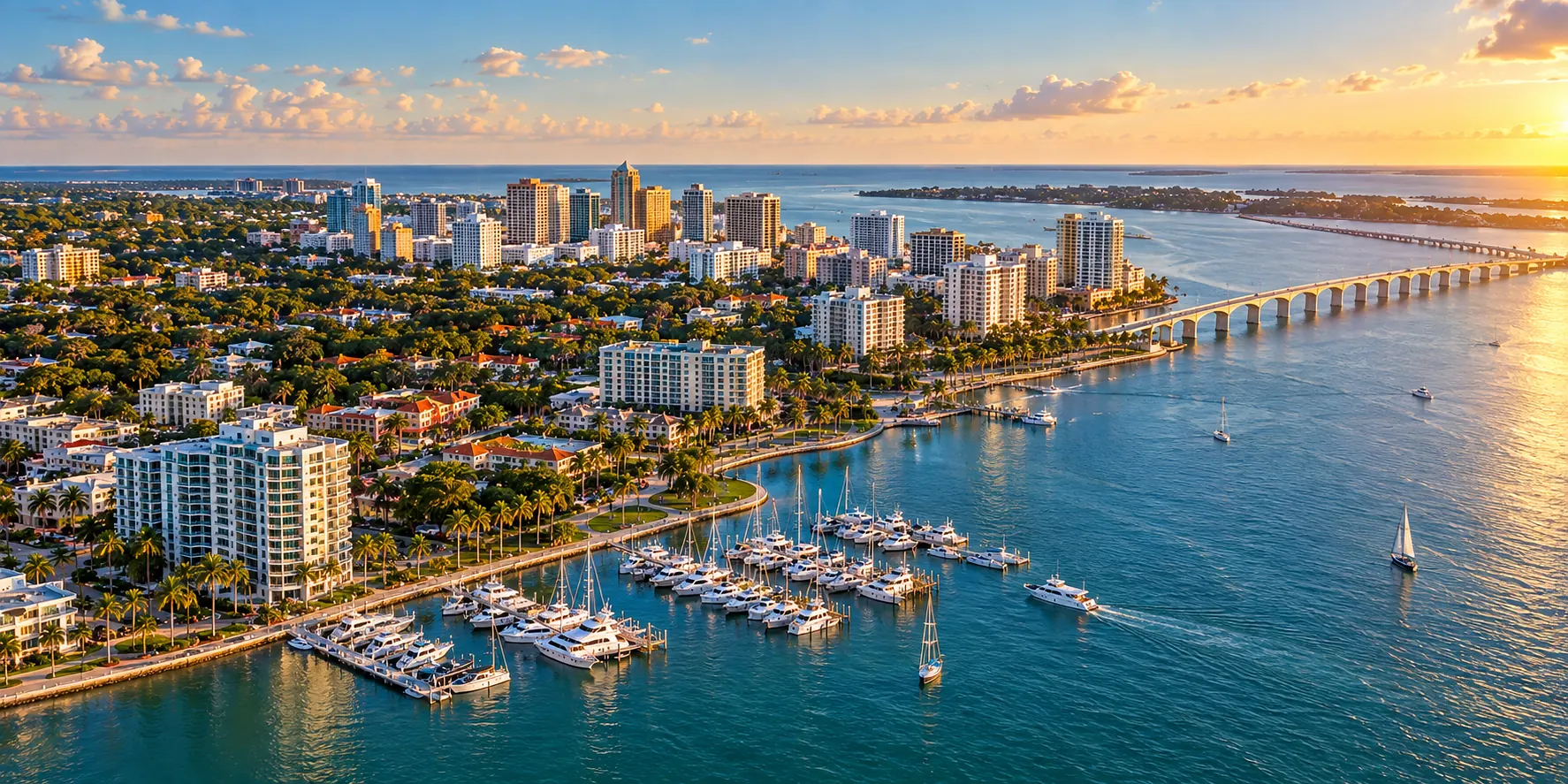
Aerial view at sunset over Sarasota Bay, Florida, with the downtown skyline, marina and the causeway out to the barrier islands

Custom home builder in Sarasota, Florida.

Custom homes built on your lot, by a licensed general contractor who is also a certified building inspector.

Build on your lot

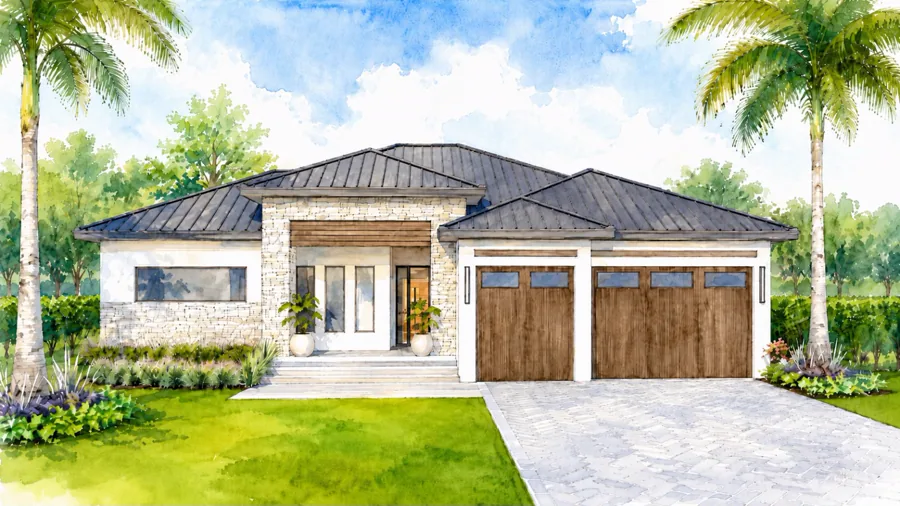
PALMA Collection
Modern CoastalSarasota, FL
Watercolor rendering of a PALMA Collection custom home with a dark metal roof and stone entry, a plan that can be adapted to a Sarasota lot
4Beds3Baths3Cars

How we build here

Building on your lot in Sarasota.

A custom home designed around your specific parcel, or one of our existing floor plans adapted to it. See the build on your lot guide.

Sarasota lots divide sharply. Barrier island and bayfront parcels come with coastal wind and flood requirements, elevation rules, and in the VE zones an open foundation rather than fill. Mainland lots in the older neighborhoods come with tree canopy, tight platting, and drainage that has to work with what's already next door. Both are real projects; they're just governed by different chapters of the code.

Trees

In Sarasota, the trees on your lot are a design constraint, not site work.

This is the single most expensive thing people get wrong here, and it's the reason a Sarasota lot cannot be designed the way a Charlotte County lot can.

In unincorporated Sarasota County, removing a native tree with a trunk more than four inches across - or a palm with more than eight feet of clear trunk - generally requires a permit. That alone is stricter than the counties to the south. But the part that changes budgets is the Grand Tree.

The designation

What a Grand Tree is

A native mature tree that scores above a threshold on a points system based on its size and height. The county's own guidance is blunt: new development is to be designed to avoid impacting Grand Trees. It is not a fee you pay to make a problem go away.

With a permit

What removing one costs

Where a permit is granted, the fee runs to a base charge plus a per-inch charge on the trunk diameter, which can be offset by replanting inch for inch. On a large specimen that reaches into five figures before a single wall goes up.

Without one

What removing one without a permit costs

Substantially more, again charged per inch of trunk diameter, and reportable by anyone who notices. This is not a risk worth carrying, and it is one a builder unfamiliar with the county has genuinely taken by accident.

Two further things that catch people. Replacement trees planted under a tree permit carry a seven-year survival obligation - if they die inside that window, the current property owner replaces them, which means the liability transfers with the house. And roughly two dozen miles of road in the unincorporated county are designated Canopy Roads, where even trimming within the protection zone needs approval.

The City of Sarasota runs its own separate tree ordinance with its own thresholds and its own procedures, including marking and posting requirements once an application goes in. Which set applies to you depends on the parcel.

Handled at the start, this is a survey, an arborist, and a floor plan drawn around what stays. Handled late, it is a redesign. We'd rather map the trees before we draw the house.

Beachfront lighting

On the coast, sea turtles decide what your windows can be.

People hear "sea turtle lighting" and picture swapping a porch bulb. On a beachfront build it reaches considerably further than that, and it is architectural rather than decorative.

Sarasota County beaches carry the largest nesting sea turtle population on Florida's Gulf Coast - an average of more than 200 nests per mile of coastline. The county regulates beachfront lighting accordingly, and nesting season runs May 1 through October 31. It sits on top of a state framework: Section 161.163 of the Florida Statutes and the state's model lighting ordinance for marine turtle protection.

Wavelength

Light color, not just brightness

White incandescent, fluorescent and high-intensity lighting visible from the beach has to be extinguished, shielded, or replaced with long-wavelength sources - amber or red LED, or low-pressure sodium. The state defines long wavelength as 560 nanometers or greater.

Fittings

Fixtures, mounting and aim

Fixtures must be downward-directed, fully shielded so the bulb or lens isn't visible from the beach, and mounted as low as the purpose allows. That constrains the exterior lighting plan, the soffit detail, and the landscape lighting together.

Glazing

And the glass

This is the one that surprises people. State guidance sets a tint standard of 45 percent or less inside-to-outside light transmittance on glass, doors and railings facing the beach - and darker is often recommended on a house with a lot of glass. Your Gulf-facing glazing is a code decision.

Two consequences worth planning around. On a new build, the lighting and glazing strategy belongs in the first design conversation, because retrofitting tint and re-aiming fixtures after a certificate of occupancy is expensive and visible. And on a renovation, this is easy to trigger by accident - in some jurisdictions here, remodeling work that alters exterior lighting or replaces glass or glazing brings a project under the ordinance even though it started as a cosmetic job.

It also runs alongside state permitting on coastal parcels: lighting compliance is a standard condition of Coastal Construction Control Line permits, which sit with Florida DEP rather than with your local building department.

Where we build

Sarasota organizes itself by where the water is.

Locals don't describe this market by zip code, they describe it by relation to the Gulf and to the Tamiami Trail. Each band builds differently.

VE zone - coastal

The barrier islands

Siesta Key, Lido Key, St. Armands, Bird Key, Longboat Key. VE zone construction, wave-load foundations, and beachfront lighting rules that reach into the glazing. The most expensive land here to get wrong.

Established - canopy

West of the Trail

Harbor Acres, Cherokee Park, Oyster Bay, McClellan Park, Southpointe Shores, The Landings. The established bayfront-adjacent addresses. Mature canopy, tight platting, and tree rules that shape the floor plan.

City jurisdiction

Downtown & the urban core

Downtown Sarasota, Golden Gate Point, Burns Court. City of Sarasota jurisdiction, urban lot sizes, and the additional review layers a historic downtown context brings.

Mainland infill

Mid-city & Palmer Ranch

Palmer Ranch, Gulf Gate, Forest Lakes, Colonial Oaks. Established mainland neighborhoods where infill happens between existing homes and drainage has to work with what's already next door.

Estate parcels

East of I-75

Laurel Oak Estates, The Founders Club, Bent Tree, Misty Creek, Oak Ford, Serenoa. Larger estate parcels, most within governed communities with architectural review, and the most Grand Trees per acre in the county.

Jurisdiction

Five building departments, one county.

Sarasota County contains four incorporated municipalities plus the unincorporated county, and each runs its own building department, its own portal, and in several cases its own tree and floodplain ordinances.

Most buildable land

Unincorporated Sarasota County

Most of the county's buildable land. Planning and Development Services moved to the PDS One Stop at 870 Apex Road in Sarasota in March 2026, with a second office in Venice. Applications through Accela.

Its own ordinances

City of Sarasota

Its own building department, its own permit portal, its own tree protection ordinance and its own CRS flood classification. Downtown and the older bayfront neighborhoods sit here.

Two counties

Town of Longboat Key

Its own department, and unusually the island spans two counties - part sits in Sarasota County and part in Manatee. It also carries its own CRS classification, which differs from the county's.

Own fee schedule

City of Venice

Its own department and portal, with its own published review times and its own fee schedule layered over the county mobility and impact fees.

Easily confused

City of North Port

Its own department. Worth noting for anyone comparing lots, because North Port and Port Charlotte were platted by the same developer in the same era and can look identical on a listing.

From the parcel

Which one is yours

Determined by the parcel, not the mailing address. It sets your portal, your review queue, your tree rules, and your flood insurance discount. We confirm it before anything is drawn.

Permitting

Getting approved to build in Sarasota.

01

How long a review takes

Plan review in unincorporated Sarasota County generally runs somewhere in the range of two to four weeks for a new single-family home, depending on complexity and current volume. The City of Venice publishes a narrower figure for a single-family residence. Either way, that is one review pass, not a permit in hand - corrections and a resubmittal are normal, and each round adds time.

The variable you actually control is the completeness of the first submittal. In a county with this many review layers, that is where a schedule is won or lost.

02

Environmental review comes before the building department

Sarasota County's environmental protection layer is not a formality. Beyond the tree rules, certain ground-disturbing activities require an earthmoving permit or a written exemption determination before work starts, and protected habitats and listed species can affect what a parcel will support.

The practical consequence is sequencing: on a Sarasota lot the environmental questions belong at the front of the project, alongside the survey, not at the point where you're ready to break ground.

03

Mobility fees and impact fees

Sarasota County charges a mobility fee on new development in addition to impact fees, with schedules that are updated periodically - a revised schedule took effect in early 2026. Municipalities layer their own fees on top of the county's. These are real four- and five-figure line items on a new home, and they are not a square-foot cost.

Ask any builder to show mobility fees, impact fees, utility connections and permit fees as separate pass-through line items with receipts, rather than folded into a per-square-foot number where you can't check them. That's how we quote them.

04

A statewide change worth knowing

Florida House Bill 803 took effect on 1 July 2026 and changed several things about residential permitting, including limited exemptions for low-value work on qualifying single-family homes and a shift away from valuation-based inspection fees. It is not a blanket exemption, structural and regulated trade work is unaffected, and splitting a larger job into smaller contracts to fit under a threshold is not permitted. On a new build it changes little; on a renovation it can matter.

Flood zones

On the islands, elevation isn't a setting - it's the whole structure.

Sarasota has more Zone VE than the markets to the south, and VE is a different building problem from AE. VE applies to Gulf-front land subject to wave action as well as flooding - the Gulf sides of Siesta Key, Lido Key, Longboat Key and Casey Key. In a VE zone you generally cannot build on fill; the home sits on an open foundation designed for wave loads, with the lowest structural member above Base Flood Elevation rather than just the floor. That is a structural decision made at the first drawing, and it drives cost more than any finish selection will.

Inland, most of the developed county sits in AE or X, with Base Flood Elevations that vary lot by lot rather than by neighborhood.

Sarasota County holds a CRS Class 5 rating under FEMA's Community Rating System, earning a 25% discount on NFIP flood insurance for properties in Special Flood Hazard Areas and a smaller discount outside them. The county has participated since 1992. But the municipalities carry their own classifications - the Town of Longboat Key, for instance, has sat at a lower class with a smaller discount. Two homes a short drive apart, same water, different annual premium.

Two elevation certificates are required during construction, not one: an "under construction" certificate before the lintel is poured, and a final certificate before your last inspection, which is what your insurer uses to set your rate.

If a structure is already on the parcel, ask about substantial damage determinations before you budget anything. Helene and Milton produced a significant number of them on the barrier islands, and a substantially damaged home has to be rebuilt to current standards including elevation - which changes a renovation into a rebuild. Establishing what was determined, and what was permitted, is work James does as a consultant and as a retained expert witness, and it belongs before an offer.

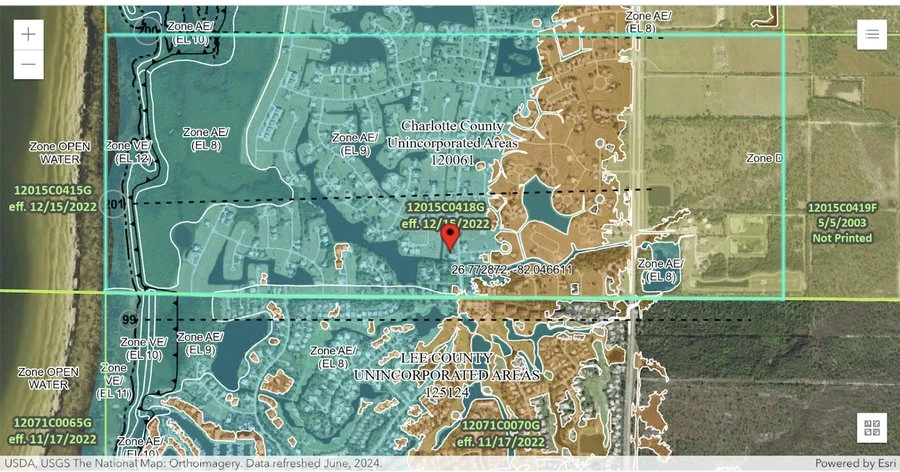
You can check any lot yourself at FEMA's Flood Map Service Center.
A FEMA flood zone map panel showing zone AE with base flood elevations alongside zone VE and open water
An example FEMA panel - the AE and VE boundary with Base Flood Elevations. Yours varies parcel by parcel.

Insurance

What it actually costs to own here.

Insurance is the line item that surprises people moving to Sarasota, and on the islands it can rival a mortgage payment. Flood is a separate policy from homeowners, and in a VE zone the premium difference between a home built at Base Flood Elevation and one built well above it is substantial and permanent.

Roof age has become the most decisive underwriting factor in Florida - many carriers won't write a new policy on a roof past fifteen years. That's the part of the buy-versus-build comparison that usually gets left out: a new home built to current wind and flood standards, with impact-rated openings and elevation designed in, insures materially better than older stock on the same street, for the life of the home.

Florida law also requires insurers to offer a discount for verified wind-resistant features, documented by an independent wind mitigation inspection. How we build for it.

We won't quote you a premium. Rates move, they're set by carrier and by address, and anyone giving you a number without your parcel is guessing. Get a quote on a specific lot and a specific plan before the design is final.

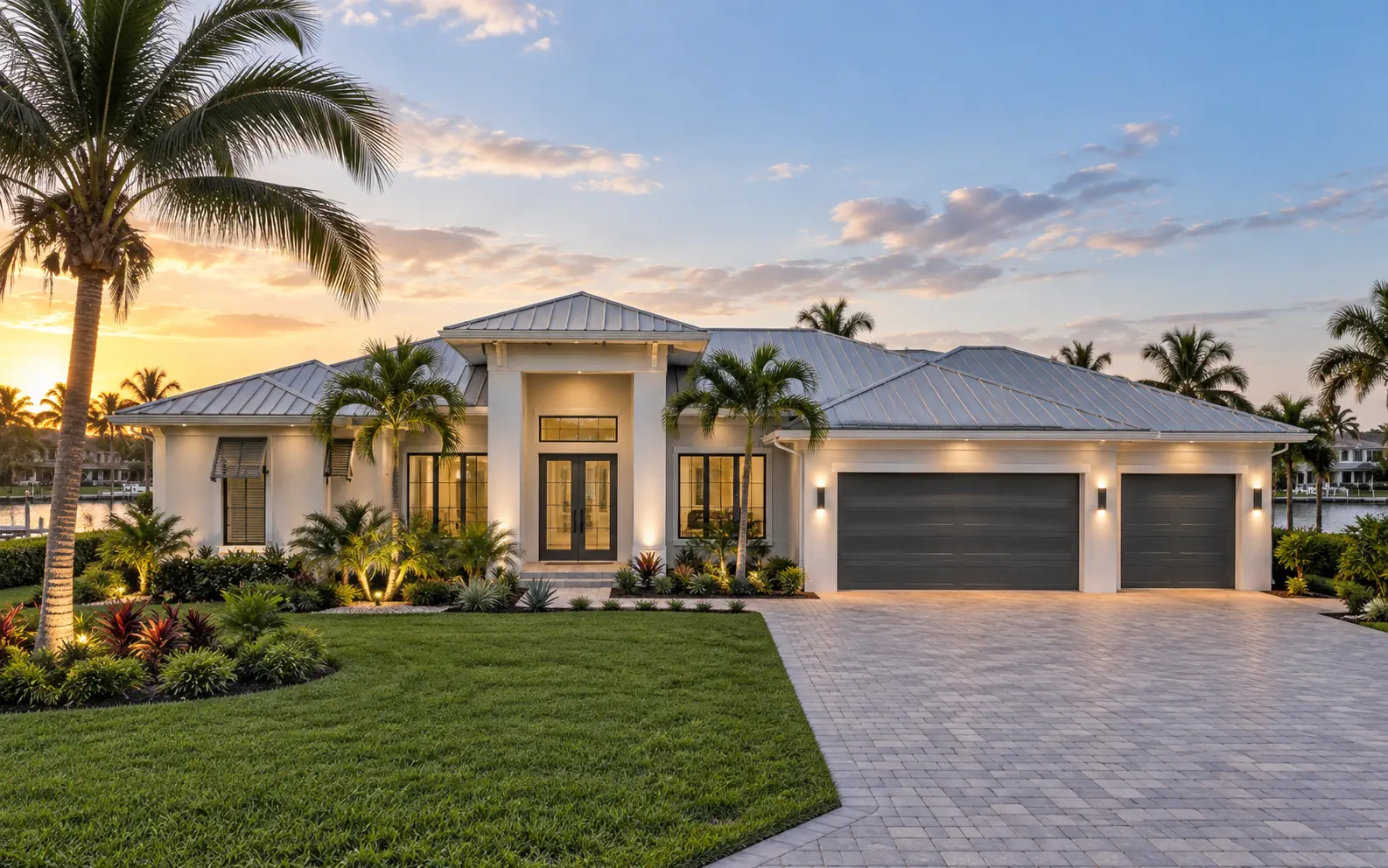
A waterfront Sarasota custom home at dusk, its standing-seam metal roof and impact-rated windows lit against the sunset behind it
Built past codeMiami-Dade rated products · impact windows · aluminum roof

More ways to build

Built for Florida, not just built to code.

Sarasota County sits in the Wind-Borne Debris Region, which means impact windows or approved shutters on new construction. We build past the requirement - Miami-Dade rated products, engineered roof systems, and a continuous load path accounted for from the first drawing rather than added at the end.

Cost

What it costs to build in Sarasota.

Our custom homes start around $270 per square foot and can reach and exceed $400, depending on size, materials, elevation, and site work. On a 2,000 square foot home that's roughly $540,000 to $800,000 and up for the house itself - before the lot, and before what your parcel needs before a house can go on it.

Sarasota is worth a specific note on this. Several of the established custom builders here start meaningfully higher than we do, and that is not a criticism of them - a thirty-year local portfolio, an in-house design studio, and a model home program are real things that cost real money to run, and for some clients they're worth every dollar.

What we'd rather you compare is what's actually in the number. Ask any builder, us included, which of these are inside the quoted square-foot figure and which are extra: site work and fill, tree permits and replanting, mobility and impact fees, utility connections, elevation requirements, the seawall or dock if there is one, and the design fees. Those items are where two quotes that look a thousand dollars apart turn out to be a hundred thousand apart.

The only estimate worth anything is one built around your actual parcel. Send us the address or the parcel number - even if you haven't bought it yet.

Why Cloud Design Build

The person who inspects other builders'
work, building yours.

Sarasota has more regulation attached to a residential lot than anywhere else we build. Protected trees, coastal wind and flood requirements, five separate building departments across one county, and an environmental review layer that starts before the ground is broken. The design question here almost always turns out to be a code question first.

  • Florida General Contractor (CGC1520746), plus roofing, mechanical, plumbing, and pool/spa contractor licenses.
  • Licensed Florida Real Estate Broker and Community Association Manager.
  • ICC-certified residential & commercial building inspector, and OSHA 30 certified.
  • B.S. in Construction Management and M.S. in International Real Estate, both from Florida International University.
  • Author of "Trouble in Paradise: Pitfalls of Buying an Existing Home."
  • Retained by real estate developers, property owners, law firms, and insurers as a construction expert.

Backed by a family construction legacy dating to 1972 - three generations of hands-on experience, not a franchise playbook.

Cloud Design Build works across Southwest Florida, from Sarasota County south through Charlotte and Lee. Building in several jurisdictions rather than one is what makes the differences between them visible - which requirements are county, which are municipal, which are state, and which ones a lot picks up because of where its boundary happens to fall.

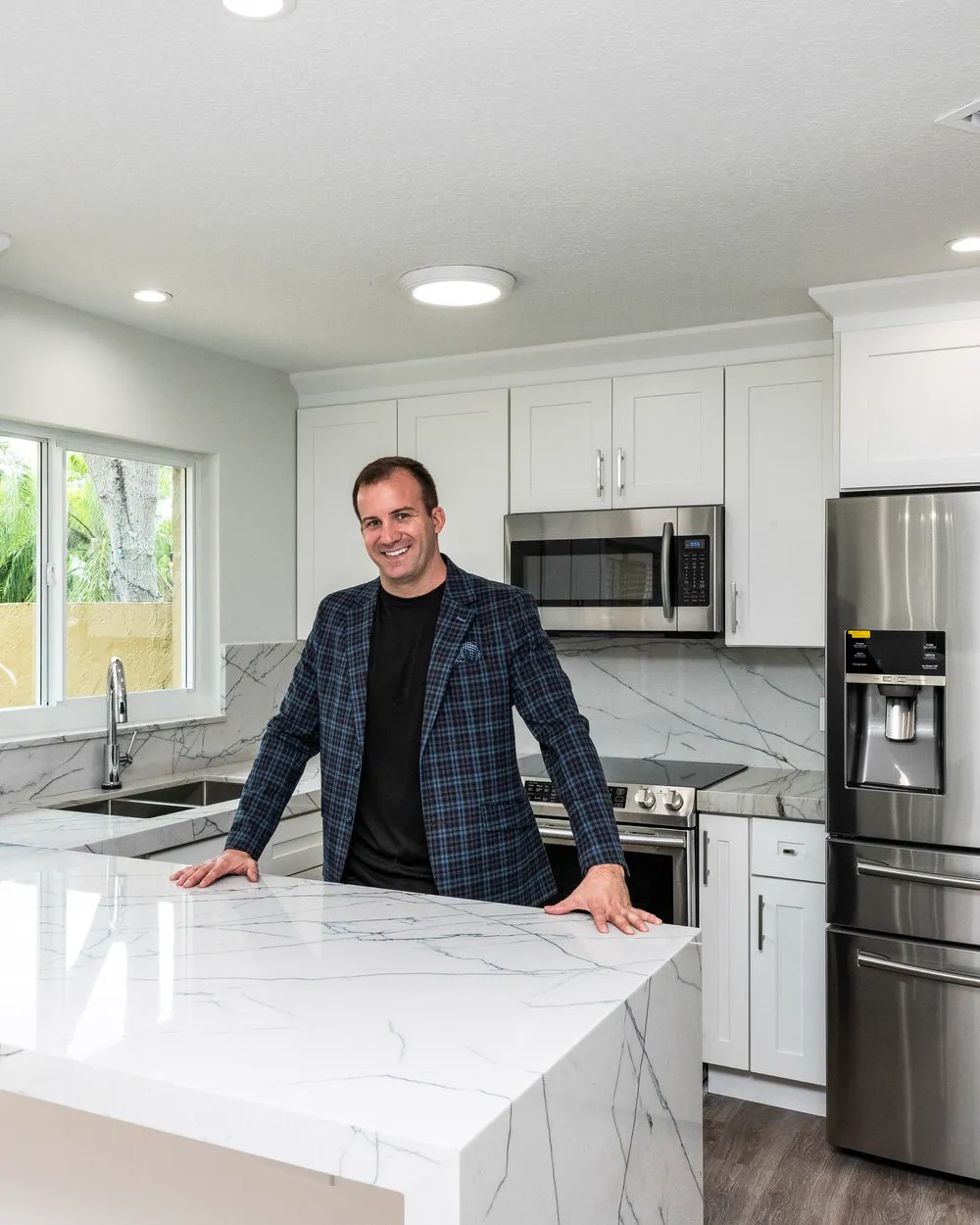
James J. Cloud, founder of Cloud Design Build, standing in a completed Cloud Design Build kitchen

Learn more

Everything you need to know before you build here.

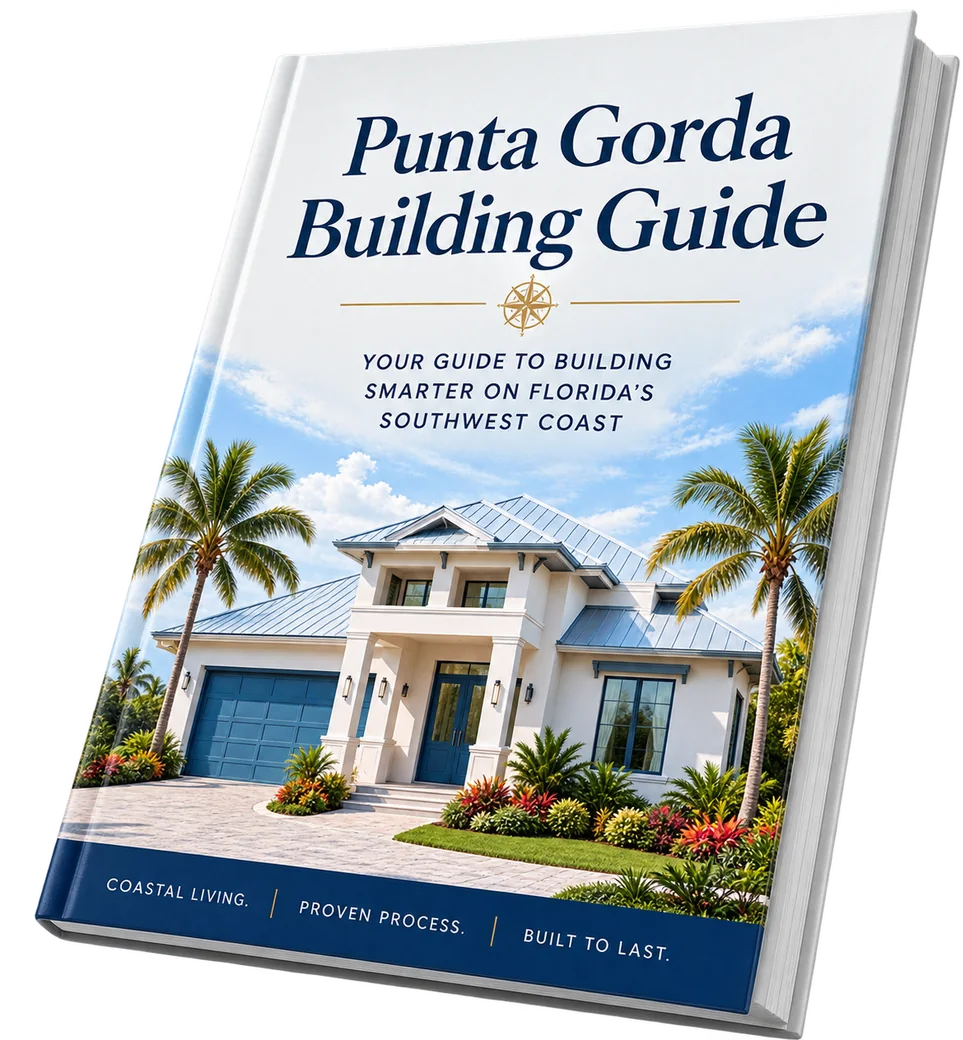
James wrote a complete guide to building in Southwest Florida - cost, permitting, flood zones, hurricane code, and what to expect if you're moving from out of state. It's written around Punta Gorda, but the flood zone, hurricane code, and relocation sections apply to Sarasota just as directly.

The Southwest Florida building guide by Cloud Design Build - cover showing a coastal custom home framed by palms

Questions

Building in Sarasota, answered.

Very likely, yes. In unincorporated Sarasota County a permit is generally required to remove a native tree with a trunk over four inches in diameter, or a palm with more than eight feet of clear trunk. Trees meeting the county's Grand Tree criteria are protected further - new development is expected to be designed around them rather than to remove them and pay. The City of Sarasota has its own separate ordinance with its own thresholds. Which applies depends on the parcel.
A native mature tree scoring above a threshold on the county's points system, based on size and height. It doesn't make a lot unbuildable, but it does change the order of work: the tree survey comes before the floor plan, and the house is designed around what stays. Where removal is permitted at all, the fee is charged per inch of trunk diameter and can be offset by replanting on an inch-for-inch basis. Removing one without a permit carries a substantially higher per-inch penalty.
On a beachfront parcel, more than most people expect. Sarasota County regulates lighting visible from the beach, with nesting season running May 1 through October 31, and the requirements reach past bulbs into fixture shielding and aim, and into the tint of Gulf-facing glass, doors and railings. That makes it a first-drawing decision rather than a finishing choice. It can also be triggered on a renovation, since work that alters exterior lighting or replaces glazing can bring an otherwise cosmetic project under the ordinance.
Yes - that's most of what we do. We design around your specific parcel or adapt one of our plans to it. See the build on your lot guide.
One of five, depending on the parcel: unincorporated Sarasota County, the City of Sarasota, the City of Venice, the City of North Port, or the Town of Longboat Key. Each has its own portal, review queue, fee schedule, and in several cases its own tree and floodplain rules. It's confirmed from the parcel, not the mailing address.
Our custom homes start around $270 per square foot and can reach and exceed $400, depending on size, materials, elevation, and site work. On a 2,000 square foot home that's roughly $540,000 to $800,000 and up for the house alone, before the lot and before site work. Tree permits, mobility and impact fees, fill, and elevation requirements can each move it materially, which is why we price from the parcel rather than a headline figure.
A great deal. VE applies to Gulf-front land subject to wave action as well as flooding, and it's found on the barrier islands. You generally can't build on fill; the home sits on an open foundation engineered for wave loads, with the lowest structural member above Base Flood Elevation rather than just the floor. It's a structural decision made at the first drawing, and it costs more than any finish choice will.
Sarasota County holds a CRS Class 5 rating under FEMA's Community Rating System, earning a 25% discount on NFIP premiums in Special Flood Hazard Areas and a smaller one outside them; it has participated since 1992. The municipalities carry their own classifications, which can be lower. Confirm which applies to your specific parcel rather than assuming the county figure.
Often that's a determination rather than a preference. A structure found substantially damaged has to be brought up to current standards including elevation, which turns a renovation into a rebuild. Helene and Milton produced a number of these determinations on the islands. Establish what was determined and what was permitted before an offer goes in, not after.
Verify the license with the Florida DBPR, including whether the trade licenses are held or subcontracted. Look at permit history through the relevant portal, not just the portfolio. Search the builder's name for construction defect claims and litigation, which say more than reviews do. Bring in an independent inspector at key milestones rather than only at the end. We'd tell you to do all of that with us too. See the red flags guide.
Yes. Cloud Design Build's home market is Punta Gorda, and we also serve Port Charlotte, Cape Coral, and Fort Myers.

Start a conversation

Let's talk about your lot in Sarasota.

Whether you already own the land or you're still comparing parcels, the most useful conversation happens before the lot is bought - and you'll have it directly with the people who do the work.