Red flags when buying an existing home in Florida: a buyer's inspection guide.
Seven categories of problems that show up again and again in Florida homes, what causes them, what they cost to ignore, and exactly what to check before you make an offer.
In this guide
Seven red flags · 10 min read
- Structural, roof & permit historyWall cracks, roof permit dates, and work that was never permitted
- Electrical & HVACDouble-tapped breakers, panel condition, and system age
- Water, plumbing & moldPipe material, leak stains, septic drain fields, and musty odours
- Insurance red flagsPast claims that follow the property, and what moves your premium
- Flood riskFlood zone versus floodplain, base flood elevation, and the 50% rule
- Condo & HOA financial healthFive years of financials, reserve funding, Milestone and SIRS
- Sinkhole riskWhere the risk is real, the warning signs, and what coverage is standard
- Frequently asked questionsShort answers to the five buyers ask most
Why Florida is different
Why this guide stays Florida-specific.
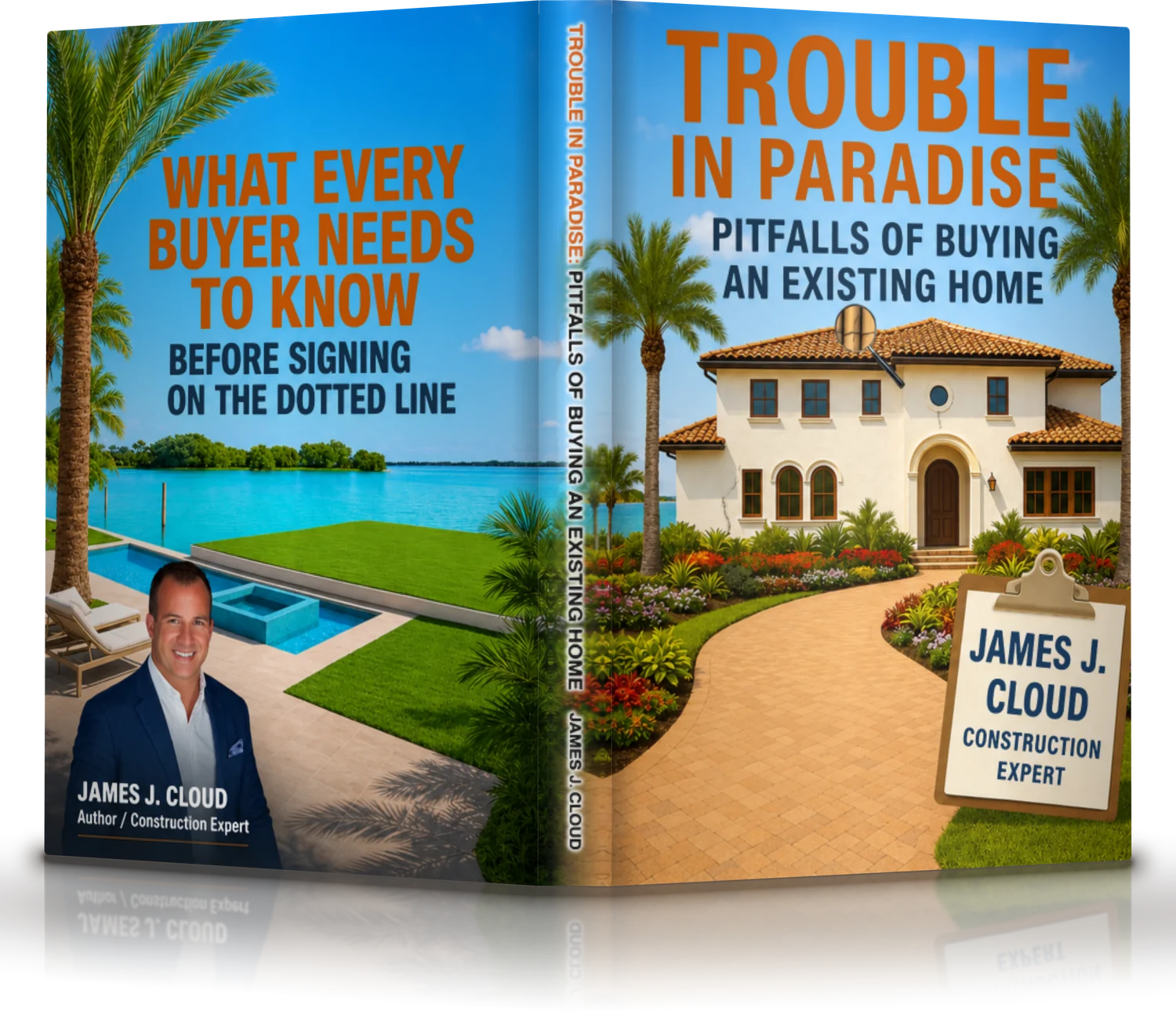
This guide is adapted from James J. CLoud book, Trouble in Paradise: Pitfalls of Buying an Existing Home, which covers construction defects and inspection red flags for buyers nationwide. This page narrows that down to what's actually acute in Florida: permit and code-violation history that follows a property for decades, insurance and flood exposure that can make or break whether a home is even financeable, and condo association finances that can turn into a five- or six-figure surprise after closing.
The book is written by a Florida General Contractor and certified building inspector, not a general real estate author, and it goes deeper on every category here, with full interviews from a roofer, a window and door specialist, a pest control expert, a condo association manager, a permitting expert, an insurance agent, a FEMA floodplain specialist, and a real estate transactions expert. If you want the fuller, national treatment, the book covers more ground. This guide is the Florida-specific version built for what you're actually about to do.
Red flag 01
Structural, roof & permit history.
Start outside. Hairline cracks in stucco are common as Florida homes settle on sandy soil and usually aren't a concern on their own. Stair-step cracks in block walls, or cracks that keep widening, are a different story and warrant a structural engineer, not just a repair estimate. For the roof, don't just look at it, find out when it was actually permitted. Checking the building department's permit record for the roof's install date is more reliable than trusting what you're told, and it directly affects whether the home is insurable.
The bigger issue is usually what you can't see from a walkthrough: unpermitted work. A screened porch, a covered lanai, an interior wall removed, all of these can sit invisibly for years until a future permit application, an insurance claim, or a sale forces the city to look. When that happens, the city treats the addition as if it doesn't exist and makes the current owner permit it from scratch, at current code, which can mean engineers, exploratory work, and tens of thousands of dollars, even for something that's been standing for twenty years.
Two things worth doing before you make an offer: request the permit history directly from the building department (or hire a permit expediter to pull it for you), and compare it against what's actually built. Check both the county property appraiser's records and the city's own records separately, they don't always agree, especially in incorporated areas. Also ask directly: has any remodeling been done, was it permitted, and is the home on city sewer or septic.
A real example from the book: a buyer closed on a home, then found the covered lanai across the back of the house had never been permitted, discovered only when they applied for a pool permit. The pool was stalled until the lanai issue was resolved, adding months and tens of thousands of dollars to a project that started as a simple backyard upgrade. Chapter 6 and its full interview with a permitting expert cover more stories like it.
Red flag 02
Electrical & HVAC.
One of the most common issues in older Florida homes is a double-tapped breaker, where two wires have been connected to a single breaker slot, usually because a licensed electrician wasn't hired for a past renovation. It looks minor. It's a real fire risk. If your inspector flags it, or you notice buzzing, scorch marks, or breakers that trip for no clear reason, get an electrician to look at the panel before you close, not after.
On the HVAC side, ask for the age of the system and any maintenance receipts. Check the air handler and ducts specifically, debris and buildup inside the coils is common when systems aren't cleaned regularly.
The book goes further on this in Chapter 3, including a personal story about a main feeder wire arcing inside an attic, and what that near-miss actually looked like.
Red flag 03
Water, plumbing & mold.
Older homes, especially those with galvanized steel or cast iron plumbing, are more prone to corrosion and eventual pipe failure. Check under sinks and around fixtures for water stains, warped flooring, or a musty smell, all of which can indicate a leak that's been going on longer than anyone's mentioned. Ask the age of the water heater too: they typically last a decade or more when maintained, but a neglected one can fail in three to five years.
If the home has a septic system, ask for maintenance documentation, and check the yard for odor or a patch of unusually lush grass over the drain field, a sign the system may be failing and feeding the lawn instead of processing correctly.
On mold specifically: look for discoloration and musty odors, and check bathrooms, kitchens, and attic spaces directly. If you're concerned, get it tested by a licensed mold professional rather than relying on a general inspection.
The book includes a full list of trustworthy, government-backed resources on mold and health if you want to research further, along with more detail on plumbing materials and what their age actually tells you.
Red flag 04
Insurance red flags.
Insurance claims follow the property, not just the seller. If the home has a claims history, it can affect your ability to get coverage and what you'll pay, even if you had nothing to do with the original claim. Ask directly whether the property has had past claims, and if so, request documentation, receipts, permits, and photos, showing the repairs were actually completed. An open or improperly closed claim can delay or even block a sale.
What actually moves your premium: the home's age relative to current codes, proximity to water, construction materials, and roof age specifically. Even a roof in good physical condition can trigger higher premiums or a denial if it's near the end of its expected insurable life. On a new build the same factors work in your favour, which is why wind mitigation features are worth understanding either way.
The book's full interview with an insurance specialist covers specific discounts to ask about and how claims history actually gets verified before a new policy is issued.
Red flag 05
Flood risk.
Worth understanding the distinction: a floodplain is a natural area that floods; a flood zone is an area FEMA has formally mapped for regulatory purposes. The two aren't the same, and FEMA's maps can be outdated by decades in some areas. A home showing as outside a mapped flood zone is not the same thing as a home that can't flood, a significant share of flood claims nationally come from properties outside mapped zones entirely.
If a home is in a flood zone, ask about its elevation relative to the base flood elevation, and ask whether the home has an existing FEMA flood policy, since older policies sometimes carry lower grandfathered rates that can transfer to a new owner. Also ask about the "50% rule" before assuming a renovation budget: exceed 50% of the home's market value in repairs while in a flood zone, and the whole structure may need to be elevated. Our Punta Gorda flood zone guide walks through how the same numbers work on a new build.
The book covers this in more depth in Chapter 5, including a full interview with a 25-year FEMA floodplain management expert on how flood maps actually get made and where they fall short.
Red flag 06
Condo & HOA financial health.
Low HOA or condo fees used to read as a selling point. In an older building, they're often a warning sign instead. If fees have stayed flat for years while the building has aged, that's rarely because costs stayed flat, it usually means reserves have been underfunded and a correction is coming. Ask for at least five years of financials to see the actual trend, not just the current snapshot.
Florida's Milestone Inspection and Structural Integrity Reserve Study (SIRS) requirements, most recently updated under HB 913 in 2025, apply statewide to condo and co-op buildings three or more habitable stories. An association that can't produce a recent Milestone Inspection report or a funded reserve study is a real signal a large special assessment could be coming. Ask directly whether one is scheduled or already underway, and see what those requirements mean for a board if you end up serving on one.
The full interview in the book, with a property management and condo association specialist, goes deeper on financial red flags, reserve funding benchmarks, and what a healthy building actually looks like.
Red flag 07
Sinkhole risk.
Worth being direct about this one: sinkhole activity in Florida is real, but it's heavily concentrated geographically, mainly Pasco, Hillsborough, Hernando, Marion, and Alachua counties, roughly the corridor between Tampa and Orlando, where the underlying limestone geology drives it. It's a genuine concern if you're buying in that part of the state, and a much smaller one along the Gulf Coast further south.
If you are buying in a higher-risk area, watch for the same signs across most sources: diagonal or stair-step cracks in block walls, doors or windows that suddenly stick, depressions or soft spots in the yard, and driveway or sidewalk cracks radiating outward. A standard home inspection can flag these symptoms but can't confirm sinkhole activity on its own, that requires a structural engineer and, if warranted, a geotechnical assessment.
One insurance detail worth knowing: Florida law requires insurers to offer "Catastrophic Ground Cover Collapse" coverage as a baseline, but full sinkhole loss coverage, a broader protection, has to be purchased separately. Florida sellers are also legally required to disclose known sinkhole activity, check the seller's disclosure form specifically for that statement rather than assuming it would come up otherwise.
About the author
Written by an inspector, not just a buyer's advocate.
James J. Cloud is a Florida General Contractor, a certified residential and commercial building inspector, and the author of Trouble in Paradise: Pitfalls of Buying an Existing Home. He also provides real estate consulting services to buyers evaluating a Florida property before they make an offer.

Questions
Buying an existing home, answered.
Start a conversation
Evaluating a home before you make an offer?
Talk to James about the specific property, and see the full national treatment of these topics in his book, Trouble in Paradise: Pitfalls of Buying an Existing Home.