Water intrusion & building envelope failures.
Water intrusion is a common source of construction disputes in Florida. Building envelope failures involving windows, doors, stucco, glazing systems, balconies, and roofing assemblies are a common source of property damage claims and construction disputes across residential, luxury, condominium, and commercial construction throughout the state.
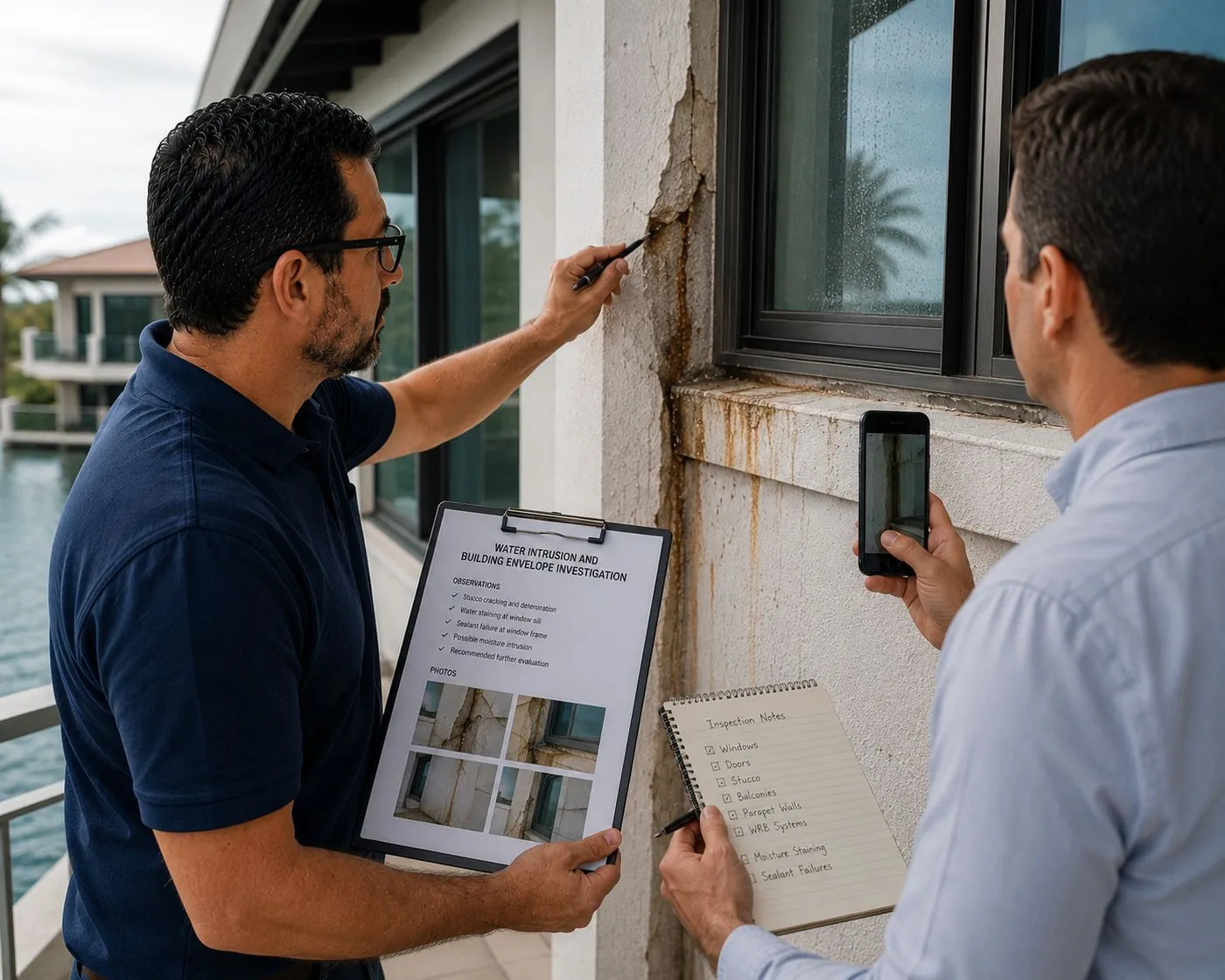
Overview
Florida Water Intrusion Investigation and Building Envelope Expert Witness Services
Florida's climate creates conditions that expose building envelope deficiencies quickly and aggressively. Intense rain events, high humidity, wind-driven moisture, and sustained UV exposure put every component of a building's exterior under continuous stress. When those components are improperly installed, incorrectly detailed, or built with non-compliant materials, water finds its way in - and the resulting damage can be extensive, costly, and difficult to trace back to its source without a thorough investigation.
Cloud Design Build provides water intrusion investigation and building envelope failure consulting and expert witness services throughout Florida, assisting property owners, attorneys, developers, contractors, and insurers in identifying the cause and extent of water intrusion conditions and supporting dispute resolution. These services are part of Cloud Design Build's broader Construction Claims Consulting practice and may include site inspections, building envelope assessments, document review, written reports, and litigation support.
Definition
What is the Building Envelope?
The building envelope refers to the physical barrier between the interior of a structure and the exterior environment. It includes the roof, exterior walls, windows, doors, glazing systems, balconies, decks, and all associated waterproofing, flashing, sealant, and drainage systems. The building envelope's primary function is to control the movement of water, air, heat, and vapor between the interior and exterior of the structure.
When any component of the building envelope fails - whether through design deficiency, improper installation, use of non-compliant materials, or lack of maintenance - water can penetrate the assembly and cause damage to structural components, interior finishes, insulation, mechanical systems, and the building's overall integrity. In Florida's climate, envelope failures rarely repair themselves and typically worsen over time if left unaddressed.
Identifying the source of water intrusion in a building envelope failure often requires systematic investigation of multiple envelope components, since water that enters at one location frequently travels through building assemblies and appears as damage at a different location. Tracing water intrusion to its actual source - rather than just its visible manifestation - is a critical part of any building envelope investigation.
Windows
Window Installation Failures and Water Intrusion
Window installation defects are among the most common sources of building envelope water intrusion in Florida residential, luxury, and condominium construction. A window that appears functional may still allow significant water infiltration if it was not properly installed - and in Florida's wind-driven rain conditions, even small installation deficiencies can result in substantial water intrusion over time.
Common window installation failures that Cloud Design Build investigates include:
- Damage to the window unit prior to or during installation - including damage to frames, seals, or glazing that compromises the window's performance before it is even in the wall
- Incorrect installation procedures that do not follow the manufacturer's approved installation instructions or applicable Florida Product Approval conditions
- Wrong fastener types - using fasteners that are not approved for the application, not corrosion-resistant in Florida's coastal environment, or not of the size and spacing required by the window's approval
- Improper buck installation - bucks that are not properly constructed, not level and plumb, not adequately anchored, or not properly waterproofed before the window is set
- Missing or improper waterproofing and flashing around windows and bucks - including failure to integrate the window flashing with the weather resistant barrier (WRB) on the wall assembly
- Wrong sealants - using sealants that are not compatible with the window system, the substrate, or the Florida climate, or applying sealant in a manner that traps rather than drains water
- Incompatible systems - combining window products, flashing systems, WRBs, and sealants that are not designed to work together, resulting in failures at system interfaces
In High Velocity Hurricane Zone (HVHZ) jurisdictions covering Miami-Dade and Broward Counties, window installations must comply with applicable Notice of Acceptance (NOA) requirements and must be installed strictly per the approved installation instructions. Deviations from NOA-approved installation methods in HVHZ jurisdictions can constitute both a code compliance failure and a construction defect. See also: Building Code Compliance.
Doors
Door Installation Failures and Water Intrusion
Door installations present similar water intrusion risks to windows and are evaluated using the same framework. Exterior door failures in Florida construction commonly involve:
- Improper installation procedures that do not follow manufacturer requirements or applicable product approval conditions
- Buck installation deficiencies that affect the door's alignment, performance, and waterproofing
- Missing or improper flashing and waterproofing integration at the door opening
- Seal failures resulting from improper installation - including door sweep, threshold, and perimeter seal deficiencies that allow water to enter at the base or sides of the door
- Incompatible sealant products that fail prematurely under Florida's UV and weather exposure
As with windows, HVHZ compliance requires that exterior door installations in Miami-Dade and Broward Counties meet applicable NOA requirements and be installed per approved installation instructions.
Glazing
Glazing System Failures
Glazing systems - including storefront systems, curtain wall assemblies, sliding glass doors, and impact-resistant glazing in Florida construction - present their own category of water intrusion and performance failure issues.
Glazing systems are also subject to finish problems. Touch-up paint applied to aluminum frames with the wrong product or preparation can fail to bond, and in Florida's UV exposure it can weather differently from the factory finish. Cloud Design Build evaluates glazing installation and finish conditions as part of building envelope investigations.
Cladding
Stucco and Exterior Cladding Failures
Stucco is one of the most common exterior cladding systems in Florida construction and one of the most frequently involved in construction defect and water intrusion claims. Stucco failures in Florida range from cosmetic cracking to complete system delamination with significant water intrusion behind the cladding.
Cracking and Water Intrusion
Cracks in stucco are among the most common defect conditions encountered in Florida residential and commercial construction. Two primary crack categories are frequently encountered:
- Foundation and structural movement cracks: Cracks that develop as a result of foundation movement, settlement, or structural deflection. These cracks may be wider, more irregular in pattern, and may reopen after repair if the underlying movement is not addressed. Whether structural movement has occurred, and why, is a question for a licensed engineer.
- Hairline cracks from mix and application issues: Fine cracks that develop during curing from an overly wet stucco mix, rapid drying conditions, or improper application technique. While individually small, hairline cracks in Florida's climate provide pathways for water intrusion that can cause significant damage over time, particularly where the cracks extend through the full stucco thickness to the substrate.
Delamination
Stucco delamination - where the stucco separates from the substrate or from underlying coats - is a serious building envelope failure that can allow significant water intrusion and may require complete removal and replacement of the affected assembly. Delamination commonly results from:
- Improper surface preparation before stucco application
- Stucco applied over incompatible substrates without appropriate bonding agents or preparation
- Water infiltrating behind the stucco assembly and saturating the substrate, breaking the bond between the stucco and the wall
- Stucco applied too wet, which can cause shrinkage cracking and bond failures during curing
Non-Compliant Materials and Systems
A significant category of stucco defect claims involves the use of stucco materials or systems that do not comply with Florida Building Code requirements or project specifications. Using non-compliant materials to build out walls or achieve finish profiles - rather than approved stucco products applied to the correct substrate and thickness - can result in systems that fail to perform, delaminate prematurely, or do not meet the code requirements applicable to the project.
Weather Resistant Barrier (WRB) Deficiencies
The weather resistant barrier installed behind the stucco system is a critical component of the building envelope assembly. Missing, improperly installed, or damaged WRB allows water that penetrates the stucco - through cracks, joints, or at penetrations - to reach the structural substrate directly. In Florida construction, WRB deficiencies are a frequently overlooked contributing factor in stucco-related water intrusion claims.
Lath Installation Deficiencies
Metal lath provides the mechanical key for stucco adhesion and must be properly selected, installed, and fastened to perform as intended. Common lath deficiencies include use of the wrong lath type for the application, inadequate fastening that allows the lath to move and crack the stucco above it, and missing lath in areas where it is required.
Control and Expansion Joints
Control joints and expansion joints in stucco systems are designed to accommodate movement and prevent random cracking. When joints are missing, improperly spaced, or incorrectly detailed, the stucco system cannot accommodate the thermal expansion and structural movement that occurs in Florida's climate, and cracking results at locations where it was not planned or detailed.
EIFS and Synthetic Stucco
Exterior Insulation and Finish Systems (EIFS), commonly referred to as synthetic stucco, are widely used in South Florida construction and are a significant source of water intrusion and construction defect claims. EIFS systems require precise installation to perform correctly, and failures frequently involve improper integration of the system with windows, doors, and other wall penetrations, missing or inadequate sealant at system terminations, and damage to the system during or after installation that is not properly repaired before painting or completion.
Premature Painting
A frequently overlooked stucco failure mode involves painting stucco before it has properly cured. When paint is applied too soon after stucco installation, the moisture still present in the curing stucco can cause the paint to burn, blister, or fail to bond properly - resulting in paint failures, water intrusion pathways, and in some cases accelerated deterioration of the stucco surface beneath.
Insufficient Stucco Thickness
Florida Building Code establishes minimum thickness requirements for stucco applications. Stucco applied below minimum thickness requirements may not provide adequate weather resistance, may crack more readily, and may not comply with the code requirements applicable to the project.
Balconies
Balcony and Deck Waterproofing Failures
Balcony and deck waterproofing failures are a common source of construction disputes in Florida condominium, multi-family, and luxury residential construction. Elevated decks and balconies present unique waterproofing challenges because they must manage standing water, thermal movement, and the loads imposed by tile, pavers, furniture, and foot traffic - all while maintaining a watertight assembly over occupied space below.
Common balcony and deck waterproofing failures that Cloud Design Build investigates include:
- Improper waterproofing membrane installation - including inadequate coverage, improper seam treatment, and failure to extend the membrane to required heights at walls and thresholds
- Inadequate slope to drain - balconies and decks that do not slope adequately toward drains allow water to pond on the surface, accelerating membrane deterioration and increasing the risk of water infiltration
- Drain placement and clogging - drains located in areas that do not effectively collect surface water, or drain assemblies that are not properly integrated with the waterproofing membrane
- Tile over waterproofing membrane failures - improper installation of tile over waterproofing membranes, including use of incompatible setting materials, inadequate coverage, or failure to allow for thermal movement
- Transition details at door thresholds - one of the most common water intrusion points on balconies, where the transition between the exterior deck surface and the interior threshold is not properly waterproofed and flashed
- Railing post penetrations through the membrane - railing posts that penetrate the waterproofing membrane without proper flashing and sealant treatment create direct pathways for water to bypass the membrane entirely
Parapets
Parapet Wall Failures
Parapet walls - the low walls extending above the roofline on flat or low-slope roof structures - are a frequently overlooked source of water intrusion in Florida construction. Parapet wall failures are particularly common in commercial construction, condominium buildings, and residential structures with flat roof sections.
Common parapet wall deficiencies include:
- Stucco-clad parapet walls that are not waterproofed on the top surface - allowing water to pond at the top of the parapet and infiltrate through the stucco and underlying wall assembly
- Inadequate or missing slope at the top of the parapet - parapets that do not slope toward the roof drain water away from the wall face, causing ponding at the parapet top and accelerating water infiltration
- Missing or improperly installed parapet caps - a properly designed and installed parapet cap provides the primary weather protection for the top of the parapet wall and should be installed to match the approved product and the project plans
- Parapet cap wind compliance - comparison of the installed parapet cap against the approved product and the project plans, including HVHZ product requirements in Miami-Dade and Broward Counties where applicable
- Improper integration between parapet waterproofing and the roof membrane - failures at the transition between the roof membrane and the parapet wall assembly are a common source of water intrusion in flat roof construction
Investigation
How Cloud Design Build Investigates Water Intrusion and Building Envelope Failures
Effective water intrusion investigation requires a systematic approach to identifying not just where water appears but where it actually enters the building assembly. Cloud Design Build's building envelope investigations are structured to trace water intrusion to its source and develop a clear, defensible understanding of the failure conditions and their causes.
Depending on the scope of the engagement, a water intrusion and building envelope investigation may include:
- Site inspection and photographic documentation of water intrusion conditions and damage
- Systematic evaluation of building envelope components including windows, doors, glazing systems, stucco, WRB, balconies, and roof assemblies
- Review of construction documents including plans, specifications, submittals, and product approvals
- Evaluation of installed work against manufacturer installation requirements and applicable NOA or Florida Product Approval conditions
- Comparison of installed envelope components against the approved products and the project plans
- Review of sealant types, flashing details, and waterproofing system compatibility
- Coordination with other technical professionals where water testing or specialized analysis is required
- Development of repair scope and cost to repair estimates
- Preparation of written investigation reports and expert opinions
- Litigation support including deposition preparation and trial testimony
Credentials
Why Cloud Design Build
Effective building envelope investigation requires understanding how these systems are actually designed and installed in the field - not just how they appear in product literature or code sections.
Cloud Design Build is led by James J. Cloud, a Florida Certified General Contractor, Licensed Roofing Contractor, Licensed Mechanical Contractor, Licensed Pool/Spa Contractor, Licensed Plumbing Contractor, and Licensed Real Estate Broker, with ICC building inspector certifications across residential and commercial construction.
James's construction experience across residential and commercial projects in Florida informs how Cloud Design Build evaluates building envelope systems and where they can fail.
Cloud Design Build's consulting and expert witness services are listed with the SEAK Expert Witness Directory, JurisPro Expert Witness Directory, and Expert Pages.
Questions
Water intrusion, answered.
Schedule a consultation
Discuss your matter with James directly.
Cloud Design Build accepts water intrusion and building envelope failure consulting and expert witness engagements throughout Florida, including Miami-Dade, Broward, Palm Beach, Collier, Charlotte, and surrounding counties. To discuss a matter, contact us to schedule a consultation.