Contractor licensing & permit compliance.
In Florida, contractor licensing and permit compliance issues are among the most common sources of construction disputes, property damage claims, and litigation. When unlicensed work or unpermitted construction is discovered, the consequences can extend to both the contractor and the property owner.
Overview
Florida Contractor Licensing Violations, Permit Compliance, and Expert Witness Services
Contractor licensing and permit compliance are fundamental requirements of Florida construction law. Every contractor performing work in Florida is required to hold the appropriate license for the scope of work being performed, and most construction work requires a building permit before it begins. When those requirements are not met, the consequences for property owners, buyers, and the legal teams representing them can be significant.
Cloud Design Build provides contractor licensing and permit compliance consulting and expert witness services throughout Florida, assisting property owners, attorneys, developers, and insurers in reviewing licensing and permit records, unpermitted construction conditions, and related construction disputes. These services are part of Cloud Design Build's broader Construction Claims Consulting practice and may include permit history research, license verification, site inspections, written reports, and litigation support.
Requirements
Florida Contractor Licensing Requirements
Chapter 489, Florida Statutes
Chapter 489, Florida Statutes, governs contractor licensing in Florida and establishes the requirements for certification, registration, and the scope of work that licensed contractors are authorized to perform. Under Chapter 489, contractors must hold the appropriate license for the specific type of work being performed - a general contractor license does not automatically authorize all specialty trade work, and specialty trade contractors must hold the applicable license for their scope. Chapter 489 also establishes the obligations of the qualifying agent - the licensed individual whose credentials authorize a contracting business to operate. Florida law places supervisory responsibilities on the qualifying agent. When a qualifying agent fails to fulfill those responsibilities, or when a license is used in a manner that violates Chapter 489, significant legal and financial consequences can follow.
State Certification vs. Local Registration
Florida contractor licenses fall into two categories. State-certified contractors hold a license issued by the Florida Department of Business and Professional Regulation (DBPR) that is valid statewide. State-registered contractors hold a license that is valid only in the local jurisdiction where it was issued and must register with each jurisdiction where they intend to work. Understanding the difference between certification and registration is important when evaluating whether a contractor was properly licensed for work performed in a specific location. Some Florida counties and municipalities also require local licenses or certificates of competency in addition to state licensing. These local requirements vary by jurisdiction and represent an additional layer of compliance that contractors must satisfy before performing work in those areas.
DBPR and the Construction Industry Licensing Board (CILB)
The Florida Department of Business and Professional Regulation (DBPR) and the Construction Industry Licensing Board (CILB) oversee contractor licensing in Florida, including the issuance of licenses, investigation of complaints, and disciplinary proceedings against licensed contractors. The CILB has the authority to suspend or revoke a contractor's license, impose fines, and require remedial education for violations of Chapter 489 and related statutes. Property owners and attorneys can verify a contractor's current license status, review complaint history, and confirm insurance and workers' compensation coverage through the DBPR's online license verification system at myfloridalicense.com. Cloud Design Build recommends verifying contractor license status before any construction engagement and as part of any licensing compliance investigation.
License lending
License Pulling and License Lending in Florida
Some contractors may use another person's license to pull permits or qualify a business without that person supervising the work. Florida law restricts these arrangements, and they can create risk for property owners.
One of the most significant and underreported contractor licensing issues in Florida is the practice of license pulling or license lending - arrangements where an unlicensed individual or business pays a licensed contractor to use their license to pull permits or qualify a company, without the licensed contractor being genuinely involved in supervising or performing the work.
How License Lending Works
In a typical license lending arrangement, an unlicensed contractor or business owner pays a licensed contractor a fee in exchange for the use of their license. The licensed contractor's name appears on the permit applications, contracts, and business registrations, but the licensed individual has little or no actual involvement in the project. The unlicensed party runs the business, hires the workers, and performs or oversees the construction work while using a borrowed license to appear compliant with Florida law.
These arrangements have become increasingly visible in recent years. It is not uncommon to find online forums and social media groups where unlicensed contractors openly solicit licensed individuals willing to lend their license for a fee. These arrangements can create serious risks for everyone involved - including the property owner who hires the company.
Why License Lending is Dangerous
When a property owner hires a contractor operating under a borrowed license, they may believe they are engaging a properly licensed and qualified professional. In reality, the licensed individual whose name appears on the permit and contract may have no knowledge of or involvement in the actual work being performed. The property owner has no meaningful protection from the licensing requirement and faces the same exposure as if they had hired an unlicensed contractor outright:
- The licensed qualifier is not supervising the work and is not accountable for its quality
- The actual contractor performing the work is unlicensed and may lack the competency the license is intended to verify
- Workers' compensation and liability insurance may be inadequate or misrepresented
- If problems arise, the property owner may find that neither the nominal licensee nor the actual contractor accepts responsibility
- Contracts entered into under a borrowed license may be unenforceable under Florida law
Identification
How License Lending Arrangements Are Identified
Identifying a license lending arrangement typically requires reviewing the contractor's licensing records, business registration documents, permit history, and actual project involvement. Key indicators include:
- The qualifying agent's name on permits and contracts does not match the business owner or the individuals actually performing the work
- The qualifying agent has no documented presence on the project - no site visits, no correspondence, no involvement in project decisions
- The business has a pattern of pulling permits under one license while operating under different management
- The qualifying agent is simultaneously the qualifier for multiple unrelated businesses
- The licensed individual cannot demonstrate knowledge of the specific project when questioned
Qualifying agent
Qualifying Agent Obligations and Failures
Under Chapter 489, Florida Statutes, a qualifying agent is the licensed individual whose credentials authorize a contracting business to operate. Florida law places supervisory responsibilities on the qualifying agent. The qualifying agent's obligations are not merely administrative - they are substantive duties that require active involvement in the business and its projects.
Qualifying agent failures are a significant source of construction disputes and licensing violations in Florida. Common qualifying agent issues include:
- Abandoned qualification: A qualifying agent leaves a contracting business and the business continues operating without designating a new qualifier within the required timeframe, leaving the company operating without a valid license.
- Nominal qualification: A qualifying agent is listed on paper but has no meaningful involvement in supervising the work, making project decisions, or ensuring code compliance - the functional equivalent of license lending.
- Multiple qualification: A qualifying agent simultaneously qualifies multiple companies, spreading their supervisory responsibilities too thin to meaningfully oversee any of them.
- Scope violations: A qualifying agent allows work to be performed under their license that falls outside the authorized scope of that license type.
When a qualifying agent fails to fulfill their statutory obligations and construction defects or damages result, both the qualifying agent and the contracting business may face DBPR complaints, CILB disciplinary proceedings, and civil liability for the resulting harm.
Permits
Permit Compliance and Permit History
Why Building Permits Matter
Building permits serve a critical function in Florida construction - they ensure that proposed work is reviewed for code compliance before it begins and that completed work is inspected and approved by the local building department before it is used or occupied. When permits are not obtained, that review and inspection process is bypassed entirely, leaving the work without independent verification of code compliance.
Permit records are among the most important documents in any construction dispute or property evaluation. Reviewing the permit history of a property can reveal what work was authorized, what inspections were conducted, whether permits were finaled and closed, and whether any violations or stop-work orders were issued. Cloud Design Build conducts permit history research as part of construction defect and licensing investigations, and recommends that property owners, buyers, and their legal teams verify permit history directly with the local building department.
Open and Expired Permits
An open permit is a permit that was issued but never finaled - meaning the work was started but the required inspections were never completed and the permit was never officially closed. Open permits are a common discovery in Florida real estate transactions and construction disputes. They may indicate that work was performed but never inspected, that required corrections were identified during inspection and never addressed, or that a project was abandoned before completion.
An expired permit is one where the authorization period has lapsed without the required work being completed and inspected. Expired permits may need to be renewed or reissued before work can continue, and in some cases the local building department may require additional inspections or documentation before a permit can be closed.
Open and expired permits discovered at closing can delay or derail real estate transactions, create financing complications, and expose the seller to claims from the buyer. In construction disputes, open permits may be evidence that the contractor failed to complete required inspections or obtain required approvals.
Permit Problems
Permit problems arise when the permit record does not match the work in place. Examples include:
- Work that differs in scope or size from what the permit covered
- Work permitted over the counter that may have required full plan review
- Permit applications naming a licensed contractor who was not involved in the work
- Inspection records that do not match the work in place
- Work performed after a stop-work order was issued
Over-the-Counter vs. Full Plan Review
Not all permits go through the same review process. Over-the-counter permits are issued for relatively straightforward work that can be reviewed quickly without detailed plan examination - minor repairs, like-for-like replacements, and certain routine work may qualify. Full plan review permits involve a more detailed examination of construction documents by building department reviewers before the permit is issued.
The distinction matters in construction disputes because work performed under an over-the-counter permit may not have received the same level of pre-construction review as work requiring full plan review. When work is performed under an over-the-counter permit that should have required full plan review, the permitting process may not have provided the oversight it was intended to ensure.
Inspections and Final Approvals
Building permits typically require one or more inspections at specified stages of construction before the work is approved and the permit is finaled. Required inspections vary by permit type and jurisdiction but commonly include foundation, framing, rough electrical, rough plumbing, rough mechanical, insulation, and final inspections. When required inspections are skipped or when work is covered before it is inspected, the building department loses the opportunity to verify code compliance at critical stages of construction.
In construction defect investigations, reviewing the inspection history of a permit can reveal whether required inspections were conducted, whether any failures or corrections were noted, and whether the permit was properly finaled. Work that was never inspected or that failed inspection and was covered anyway represents a significant compliance concern.
Evaluation
How Cloud Design Build Evaluates Contractor Licensing and Permit Compliance
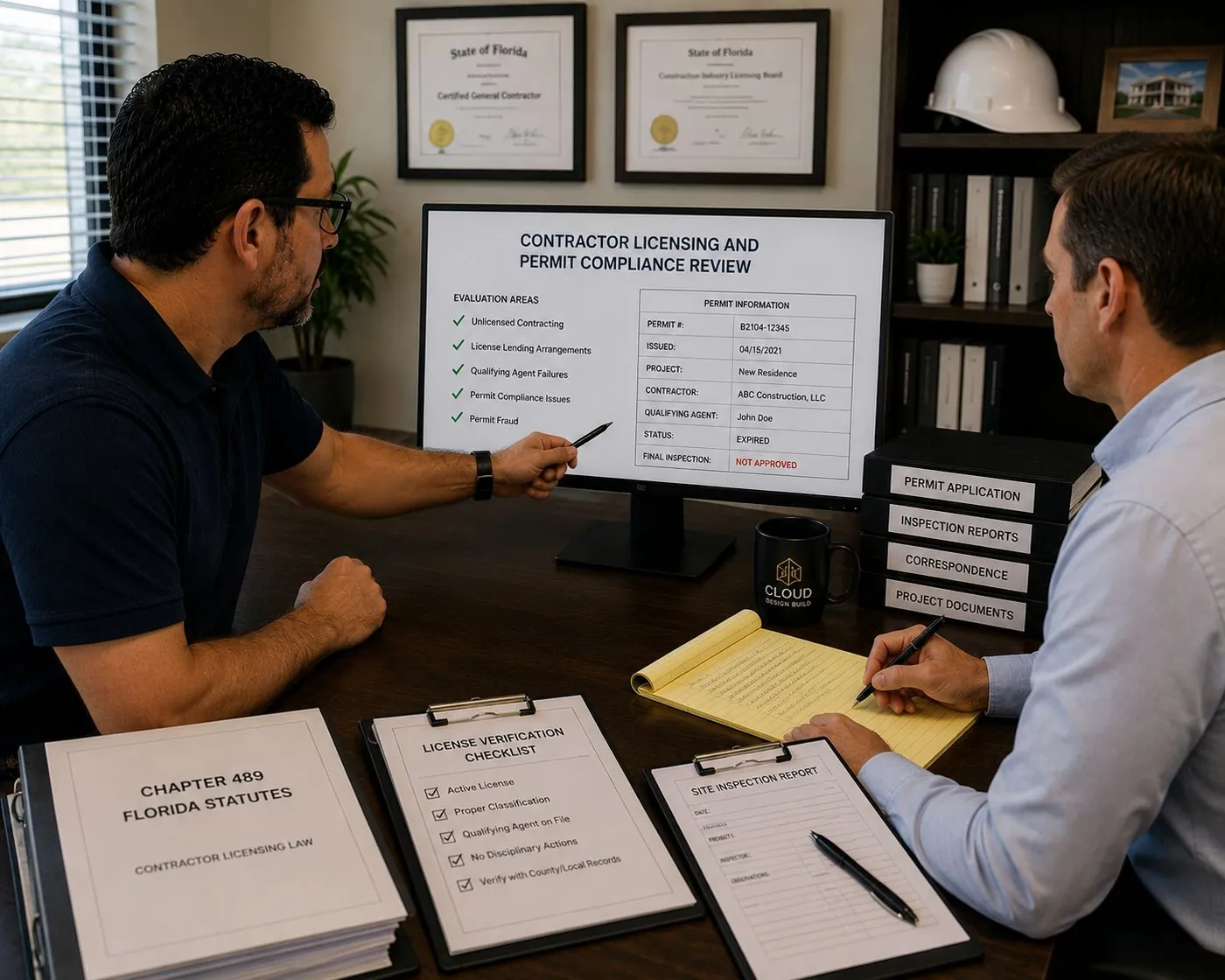
Evaluating contractor licensing and permit compliance requires a systematic review of licensing records, permit history, project documentation, and field conditions. Cloud Design Build's evaluations are designed to develop a clear, defensible record of the licensing and permitting status of a project.
Depending on the scope of the engagement, a contractor licensing and permit compliance evaluation may include:
- Verification of contractor license status, license type, and scope of authorization through DBPR
- Review of qualifying agent records and business registration documentation
- Review of licensing and permit records and documentation relevant to alleged licensing or permit issues
- Permit history research with the local building department
- Review of issued permits, inspection records, and final approval status
- Identification of open permits, expired permits, and unpermitted work
- Site inspection to document as-built conditions and compare against permitted scope
- Review of local licensing requirements and applicable county or municipal amendments
- Preparation of written reports and expert opinions
- Litigation support including deposition preparation and trial testimony
Consequences
Consequences of Contractor Licensing and Permit Violations
Licensing and permit problems can affect property owners and contractors in many ways, including insurance, financing, property sales, code enforcement, and contract enforceability. The consequences depend on the facts and the law, so consult a Florida construction attorney.
Credentials
Why Cloud Design Build
Evaluating contractor licensing and permit compliance issues effectively requires a genuine understanding of how the Florida licensing system works in practice - not just what the statutes say.
Cloud Design Build is led by James J. Cloud, a Florida Certified General Contractor, Licensed Roofing Contractor, Licensed Mechanical Contractor, Licensed Pool/Spa Contractor, Licensed Plumbing Contractor, and Licensed Real Estate Broker. As an active licensed contractor in Florida, James operates within the same licensing and permitting framework that is at issue in these disputes every day. That direct, current experience provides a level of practical insight into how licensing requirements apply, how permit processes work, and how violations occur that is difficult to replicate from a purely academic or advisory perspective.
Cloud Design Build's consulting and expert witness services are listed with the SEAK Expert Witness Directory, JurisPro Expert Witness Directory, and Expert Pages.
Questions
Licensing & permit compliance, answered.
Schedule a consultation
Discuss your matter with James directly.
Cloud Design Build accepts contractor licensing and permit compliance consulting and expert witness engagements throughout Florida, including Miami-Dade, Broward, Palm Beach, Collier, Charlotte, and surrounding counties. To discuss a matter, contact us to schedule a consultation.